Piscataway Roofing has spent more than 20 years on roofing in Berkeley Heights and across central New Jersey, and some of the jobs that take the most care here are not detached houses at all. A townhouse roof raises a question before anyone climbs a ladder: who is actually allowed to hire the work. We answer that one first, from the community’s own documents, so an owner never signs an estimate for a roof that belongs to someone else.
Once the paperwork settles who holds the roof, the job runs like any careful roofing job. We trace a leak from the attic side as well as from the shingles, we tell you plainly whether a repair will hold before replacement comes up, and every scope we write breaks tear-off, decking, underlayment, flashing, ventilation and gutters into separate lines. That format matters even more when a board is comparing bids from several contractors.
This page is written for owners and board members in attached-home communities, though we roof detached houses across the township too. It covers how roof responsibility gets assigned, what changes when a roof is shared property, why an attached re-roof goes through the permit office, and how we plan work on a row of joined units.
Townhouse Roofs in Berkeley Heights
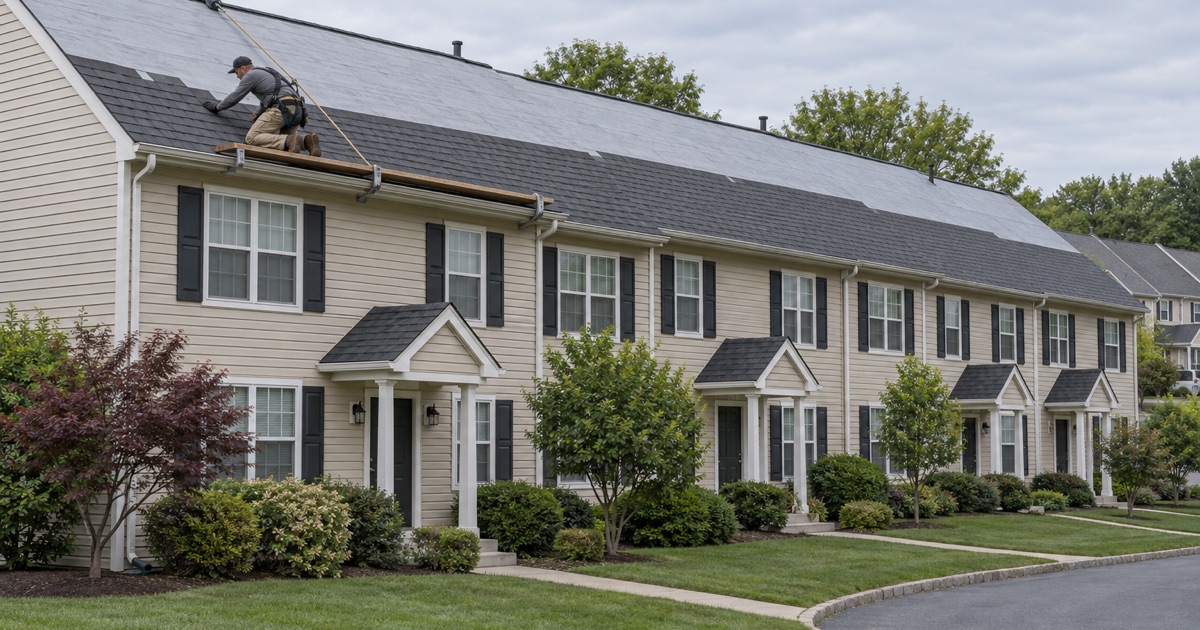
Berkeley Heights is mostly a town of detached houses, but its attached stock is not small. The American Community Survey 2024 five-year estimates count 405 single-family attached homes in the Union County township, 8.3% of its 4,905 housing units. The same survey places all 405 in owner-occupied homes and none in rentals, though that zero renter count is an estimate with a margin of error.
Communities Built in the 1990s
Recent listings name several townhouse communities, including Berkeley Square and Berkeley Village, both with homes built in 1996, and Bridle Club, with a townhome built in 1991. Braemar at Berkeley Heights and Berkeley Meadows appear on listings as well. The survey counts 502 of the township’s housing units as built between 1990 and 1999, which puts much of this attached stock roughly 30 to 35 years past construction.
What Listings Do and Do Not Tell You
One Berkeley Square end unit built in 1996 lists an asphalt shingle roof and a monthly community fee of $906, while a Braemar listing shows $650 a month. Neither listing says what the fee covers, and none of the listings we have read states whether the owner or the association maintains the roof. That silence is the reason we start with the community documents rather than the shingles.
An Owner-Occupied Market
Because these homes are lived in by the people who own them, the owner usually notices the leak first and calls first. That is useful, as long as everyone understands that the person with the stain on the ceiling and the party with authority over the roof may not be the same. Sorting that out quickly keeps a small leak from waiting weeks for the right approval.
Selling a Townhouse
A buyer’s inspector will look at the roof, and a buyer’s attorney may ask who is responsible for it. For owners getting ready to sell, we provide a written roof condition report that can be handed to the buyer’s inspector, describing what we found without guessing at what the documents say. Pairing that report with the relevant page of the declaration answers most questions before they slow down a closing.
Looking for roofing closer to South Amboy? See Roofing Services in South Amboy.
Owner or Association: Reading the Master Deed First
In New Jersey, who replaces a townhouse roof is not set by town code. It is written in each community’s master deed or declaration, the recorded document that created the community and divides the property into what each owner holds and what is shared. Two communities built the same year a mile apart can answer the question in opposite ways.
Condominium Versus Fee-Simple Ownership
Some attached communities are condominiums, where the owner holds the unit and an undivided share of everything else. Others are fee-simple homeowners associations, where each owner holds a lot and the structure on it, and the association handles defined shared areas. The master deed or declaration says which kind a community is, and it usually spells out whether roofs fall on the owner’s side of the line or the association’s.
How We Check Before We Estimate
Before we write a number for any townhouse or condominium roof, we ask to see the governing documents or confirm the answer with the property manager in writing. If the roof belongs to the association, we work through the association, and if it belongs to the owner, we still note any architectural rules on shingle color or product. We would rather spend a day confirming responsibility than hand an owner a contract they have no right to sign.
Questions Worth Asking the Manager
Ask whether the roof, the gutters and the flashing at shared walls are all assigned to the same party, because a declaration can treat them differently. Ask whether the community has an approved shingle line, so a single replaced unit still matches the rest of the row. Ask, too, how the board handles a leak that crosses from one unit into the next.
When the Roof Is a Common Element
Where the master deed makes a roof one of the common elements, New Jersey’s Condominium Act takes the hiring decision out of the individual owner’s hands. Section 46:8B-18 of the Act says no unit owner shall contract for or perform maintenance, repair or replacement of the common elements except through the association. An owner in that position cannot simply hire a roofer, however urgent the leak looks from the bedroom.
What That Means for an Owner With a Leak
The right first call is to the association or its manager, with photos of the ceiling and the date the water appeared. The same law gives the association access to each unit during reasonable hours as needed to repair common elements, so expect the crew to need the attic or top floor. When the association brings us in, we trace the water from inside and outside before anything is priced, and we send the findings to the board rather than leaving them with whoever opened the door.
Working for a Board
Boards usually compare several bids, and a single lump-sum figure makes that nearly impossible. Our itemized scopes let a board line up each bid against the others, and decking found rotten once the old roof is off is photographed and shown before it is replaced, at a per-sheet price fixed in the contract. That gives a board something it can explain and defend at a membership meeting.
Warranty Terms Change With Ownership
Manufacturer warranties are written around who owns the building. GAF’s Lifetime shingle warranty, for example, is limited to single-family detached homes owned by individuals, while buildings owned by a condominium or homeowners association receive a 40-year warranty instead. We put the applicable term in writing so the board and the owners know what coverage they are actually buying.
Storm Damage and Shared Claims
After wind or hail, the question of who holds the roof decides whose insurance policy responds, so we photograph the damage and write it up for whichever party owns the claim. When asked, our crew will meet the adjuster on site and walk the roof with them. Where several units are damaged in one storm, a single report covering the whole building keeps the board and the owners working from the same set of facts.
Attached Re-Roofs: Permits and Planning the Row
New Jersey treats roof-covering repair and replacement on detached one- and two-family dwellings as ordinary maintenance that needs no permit. Attached dwellings are left off that list. A re-roof on a Berkeley Heights townhouse therefore goes through the township’s construction office as permit work, whether the owner or the association is the one hiring.
What the Permit Changes on the Job
A permit adds an application and an inspection to the schedule, so the start date depends on the township as well as on the weather. We build that time into the plan from the first conversation rather than surprising anyone the week of the tear-off. On a row of units, we also talk with the board about whether the applications should be filed for the row together or unit by unit.
Replacing Roofs Across a 1990s Row
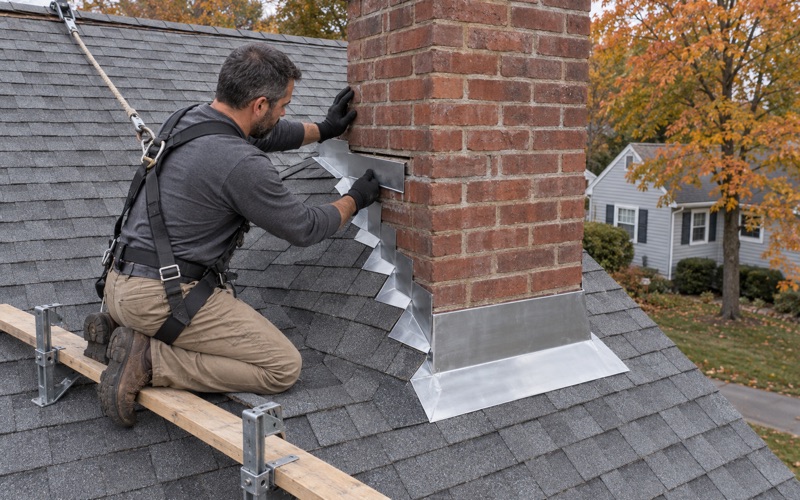
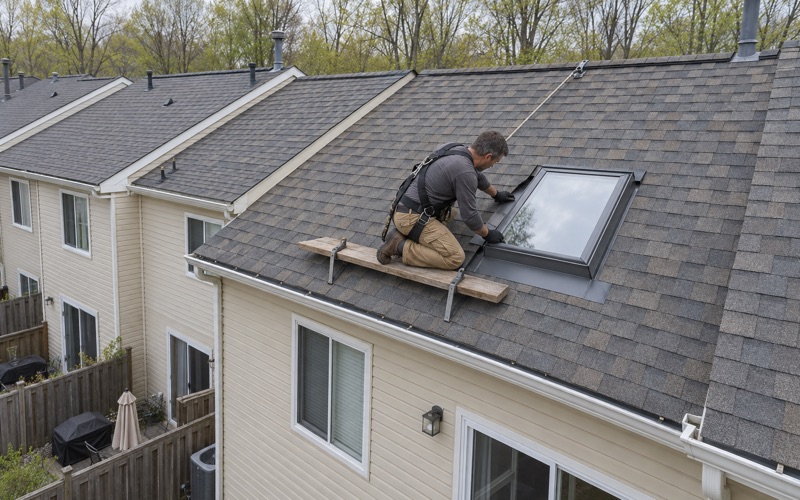
A townhouse row shares ridgelines, valleys and party-wall flashing, so the work at each end of one unit affects the next. When a board or a group of owners replaces several connected roofs together, we can run continuous underlayment and ridge vent along the row and replace step and counter flashing at every wall instead of tying new shingles into old metal. When only one unit is done, the joint with the neighbor needs extra care so water cannot travel under the seam.
Ventilation and Gutters on Joined Units
Attic ventilation gets checked on every replacement we do, because a roof that cannot breathe ages from underneath. In attached homes the attic spaces may be divided between units, so we confirm intake and exhaust for each one rather than assuming a single ridge vent serves the whole building. Gutters and leaders are sized and pitched with the roof, which matters on a row where one downspout can carry water from more than one unit.
Keeping a Shared Site Clean
Townhouse communities share driveways, walks and parking areas. Our crews clean driveways, yards and gutters at the end of every work day, including a magnet sweep for roofing nails, so neighbors are not left stepping around debris. Contracts follow New Jersey’s home improvement rules, including the three-day cancellation notice, whether the signature on the contract is an owner’s or a board’s.
- 20+ Years Roofing
- Itemized Written Estimates
- Attic-to-Ridge Leak Tracing