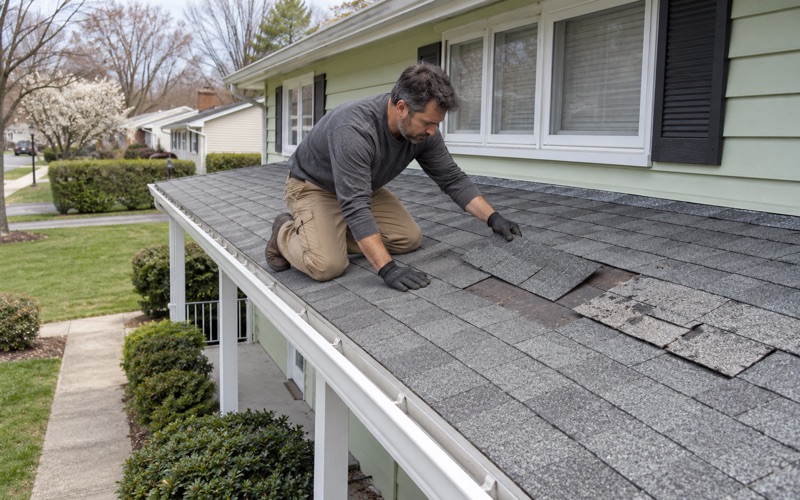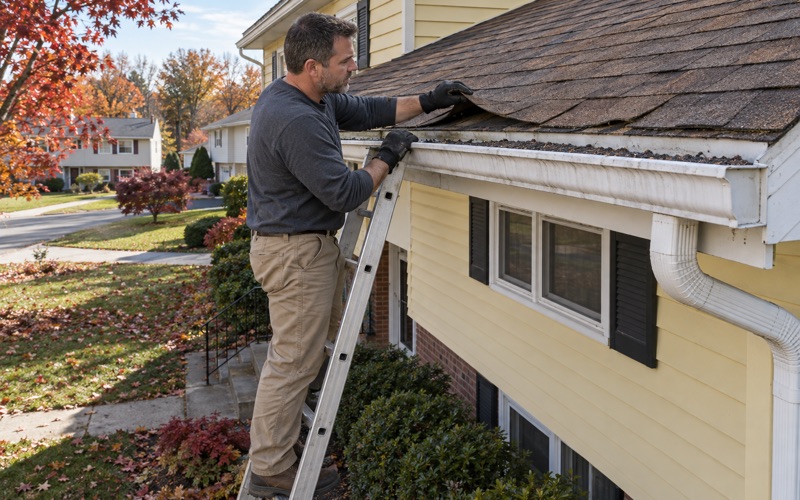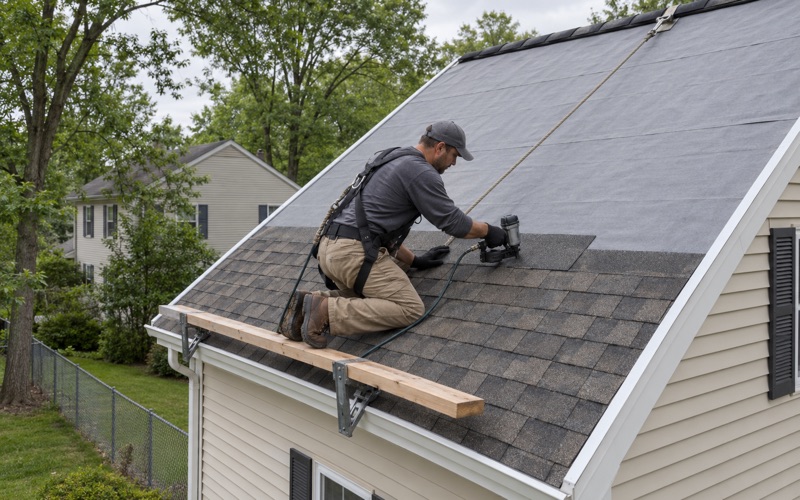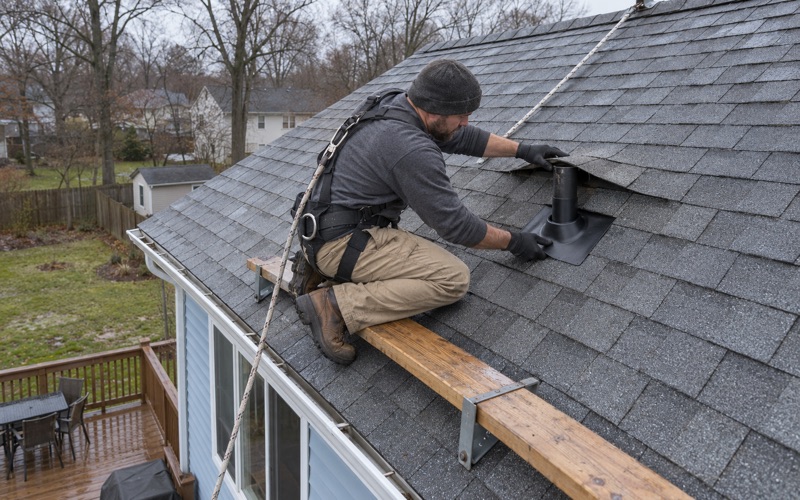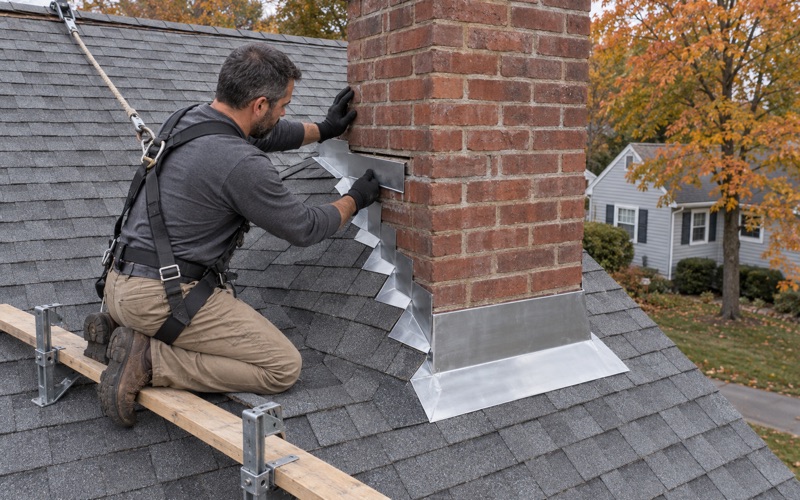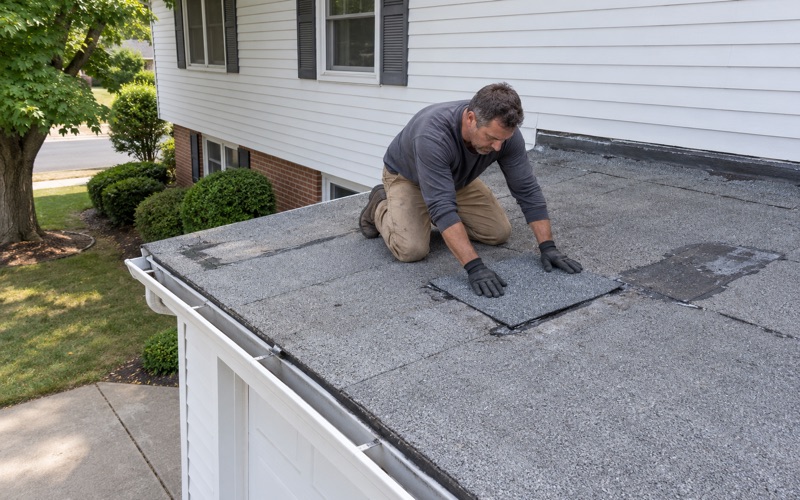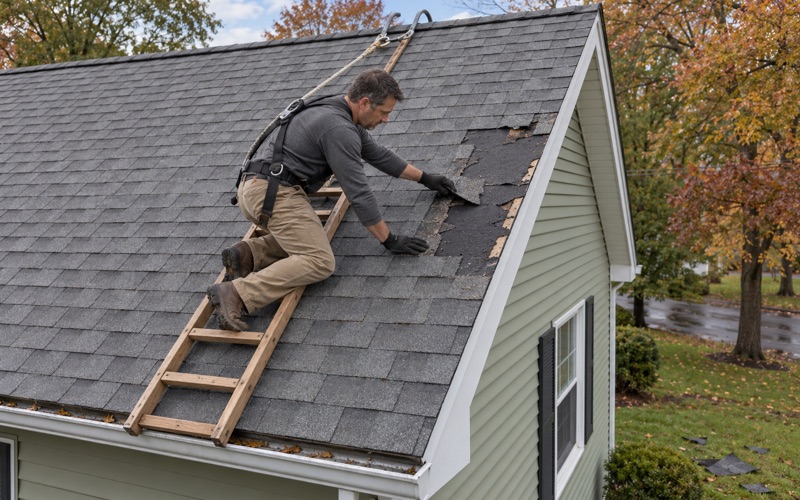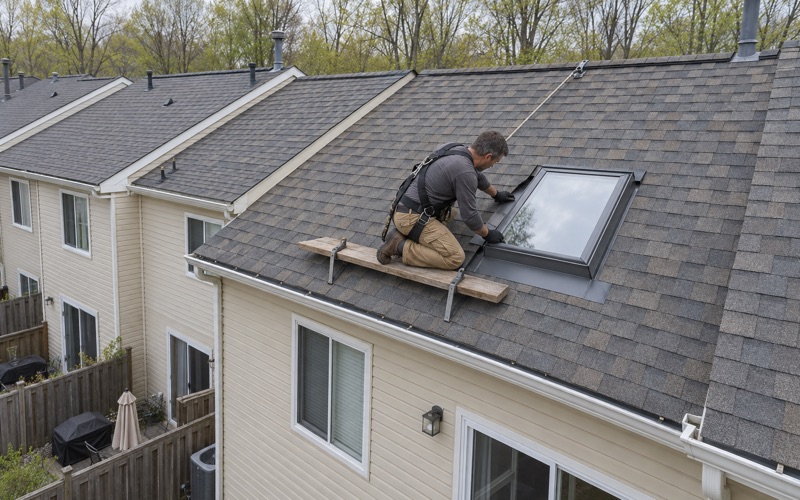
Piscataway Roofing has handled roofing in Bound Brook for more than 20 years, on jobs that range from a detached house with one leak over the kitchen to a mid-rise apartment roof with tenants living underneath it. The first visit looks the same on both. We go into the attic or the top-floor ceiling space as well as onto the roof, and we follow the water back to where it actually enters before a single line gets priced.
Whether the roof can be repaired is the first answer you get from us. Replacement only enters the conversation when a repair would not hold, and when it does, the written scope breaks out tear-off, decking, underlayment, flashing, ventilation and gutters as separate lines. An owner holding two bids can lay them side by side and see exactly where they differ.
Most of this page is about the flat roofs on the borough’s newer and larger buildings, because those jobs raise questions a shingle roof never does: whose equipment sits up there, who can switch it off, what the permit covers, and how a membrane gets replaced while people live on the floor below.
Bound Brook’s rebuilt downtown and the roofs on top of it
Bound Brook is a Somerset County borough of 11,988 people (2020 census) along the Raritan River, and its downtown has been changing shape for more than a decade. In December 2010 the borough adopted a Downtown Urban Design Plan with the Regional Plan Association, and a 2014 zoning update was drawn up to move the Business/Residential district from a two-story maximum toward buildings of three to five stories. The current zoning text is a question for the borough, but the buildings that followed show the direction.
Meridia Main Street brought 240 apartments to the circle where East Main Street meets Bolmer Boulevard, under a quarter mile from the train station. Across the borough, 621 homes, 13.2 percent of all housing units, now sit in buildings of 50 or more units, according to the Census Bureau’s 2024 five-year estimates. Buildings at that scale almost always finish with a low-slope roof behind a parapet rather than a pitched roof of shingles.
What these flat roofs are made of
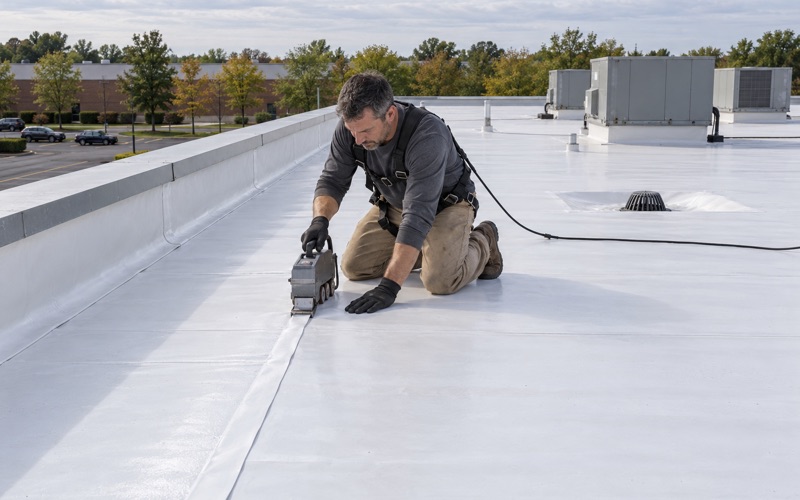
Low-slope roofs on apartment and mixed-use buildings are usually single-ply membranes such as TPO, PVC or EPDM rubber, or torch-down modified bitumen in SBS or APP. Each has its own seam method and its own way of failing. TPO and PVC seams are heat-welded, EPDM seams are taped or adhered, and modified bitumen laps are fused with a torch. On a roof this size, most leaks start at the edges, drains and penetrations rather than in the open field of the membrane.
Ordinance 2026-16 and Redevelopment Area 1
On April 14, 2026, the Borough Council introduced Ordinance 2026-16, which amends Redevelopment Area 1, Sub-Area 1.6 to revise its permitted-use standards and allow an increase in rooftop appurtenance height for antennas. Its public hearing was set for May 26, 2026. We have not read the ordinance text, so we cannot tell you the new height or which lots fall inside the sub-area; the borough’s published ordinances are the place to confirm both.
For a roofer the takeaway is simpler than the zoning language. Rooftop antennas are an expected part of downtown roofs in Redevelopment Area 1, and their presence changes how a re-roof has to be planned, from the permit to the day the crew goes up.
Looking for roofing closer to Metuchen? See Roofing in Metuchen.
Why re-roofing an apartment or mixed-use building is permit work
New Jersey draws a clear line here. Replacing the roof covering on a detached one- or two-family dwelling is ordinary maintenance under N.J.A.C. 5:23-2.7(c), and no permit, inspection or notice to the enforcing agency is required for it. That exemption is narrow, though, covering only detached one- and two-family houses, and everything else stays inside the permit system.
That reaches well past downtown. In Bound Brook, 449 housing units are attached homes and 500 more are in three- or four-unit buildings, and none of those roofs qualify for the exemption. A mid-rise apartment building or a storefront with apartments above it is construction-permit work, handled by the Bound Brook Building Department, which is headed by the borough’s Construction Official and keeps its offices at Borough Hall, 230 Hamilton Street. Call ahead for current hours and submission requirements, since we have not confirmed them.
What a permitted re-roof changes
A permitted job means describing the roof system before work begins, inspections at the stages the official sets, and a closeout once it is done. It also means the scope has to be settled up front rather than adjusted once the old membrane is up. Our line-by-line scopes help here: tear-off, deck repair, insulation, membrane, flashing and drainage each carry their own number, so the owner, the property manager and the permit application all describe the same job.
Layers and decking on older buildings
Bound Brook’s housing runs old as well as new, with 27.6 percent of units built in 1939 or earlier. On older buildings, the NJ rehabilitation subcode (N.J.A.C. 5:23-6) calls for a tear-off rather than another layer when two or more roof coverings are already in place. Once the old roof is off, any damaged decking is photographed and shown to the owner before it is replaced, at a per-sheet price written into the contract beforehand.
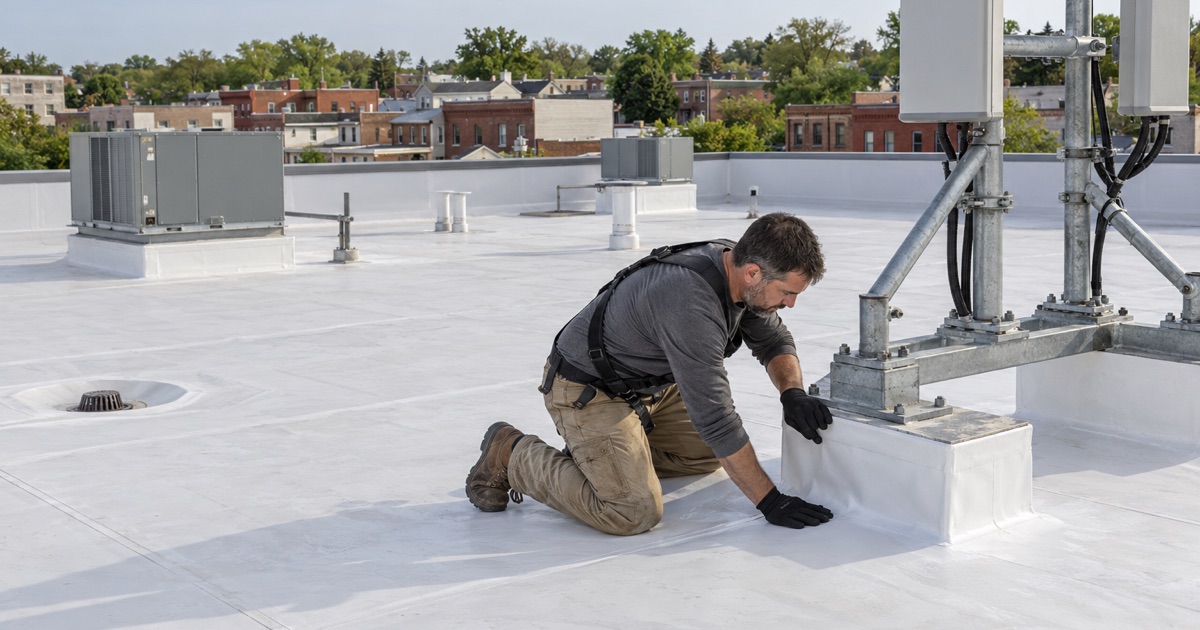
Working around rooftop antennas: who controls them
Federal rules set two tiers of radio-frequency exposure limits. Under 47 CFR 1.1310, the higher occupational, or controlled, limits apply to people exposed through their work only when they are fully aware of the potential for exposure and can exercise control over it. Being fully aware means having received written or verbal information fully explaining the potential exposure and, except for transient persons, appropriate training. Anyone else, worker or not, is held to the general population limits.
A roofing crew sits in an awkward spot under that rule. Our people are on the roof to replace a membrane, not to service antennas, and the equipment belongs to someone else. An OSHA construction advisory committee work group named roofers in 2012 among the third-party trades who work near rooftop antennas, and the practical question never changes: who owns this equipment, and who can turn it off?
Power-downs belong to whoever controls the antennas
An article in the NRCA’s Professional Roofing magazine (2010) noted that wireless providers often power down antennas to protect their own employees, and that coordinating power-downs on a roof shared by several providers is complex. We have no arrangement with any carrier and cannot order a power-down ourselves. That request runs through the building owner or manager, who holds the lease agreements and knows which providers are on the roof.
What we ask before anyone goes up
Before a crew is scheduled on a roof with antennas, we ask the owner or manager for three things: which providers have equipment there, a contact for each, and whether a power-down has been confirmed for the work days. When equipment sits on or near the area being replaced, the schedule is built around that confirmation rather than around our calendar. No federal rule sets what an RF sign must say, so a roof with no sign is not proof that nothing up there is live.
Mounts, cables and sleds on the membrane
Antenna mounts, cable runs and equipment sleds often penetrate or rest on the roof surface. Each penetration needs its own flashing detail in the new system, and frames or sleds may need to be lifted or shifted by the provider’s own crew so the membrane can run continuously underneath. We list those items as separate scope lines so nobody discovers them halfway through the job.
Planning a membrane replacement over occupied apartments
A mid-rise re-roof rarely happens in an empty building. Tenants are home, businesses are open on the ground floor, and the roof is the ceiling of the top-floor apartments. The work has to be staged so that no section is left open overnight and the drains keep working while the old system comes off.
Sequencing the tear-off
We plan the roof in sections that can be torn off, dried in and closed the same day. The membrane choice matters here. TPO and PVC can be heat-welded without open flame, which many owners prefer over occupied units, while torch-down modified bitumen puts flame at the roof surface and calls for its own precautions. EPDM is adhered or mechanically fastened and seamed with tape, and we talk through which system suits the building, the deck and the budget rather than defaulting to one.
Flashing, parapets and drainage
Parapet walls, curbs, scuppers and drains are where low-slope roofs leak, so the flashing at each of them is replaced with the roof instead of being reused under new material. Drainage gets checked at the same time, and any gutters and leaders on lower roofs are sized and pitched so water leaves the building instead of collecting at the foundation. Ventilation and moisture under the deck are looked at on every replacement, because an assembly that cannot shed moisture ages from underneath.
Keeping tenants and owners informed
For landlords, we schedule the noisiest work around tenants where we can and send photos after each visit, so an owner who lives elsewhere can follow progress without driving over. Entrances, sidewalks and parking areas are cleaned at the end of every work day, including a magnet sweep for roofing nails. Where a job counts as home improvement work, the contract is written to New Jersey’s home improvement rules, including the three-day cancellation notice.
- 20+ Years Roofing
- Itemized Written Estimates
- Attic-to-Ridge Leak Tracing