Piscataway Roofing handles chimney repair in Piscataway, NJ, serving surrounding cities including Middlesex, Highland Park, Bound Brook, Metuchen and Manville. In more than 20 years of roofing work, chimneys have been the single most common source of the leaks we trace. Our chimney work focuses on where the chimney meets the roof and on the top of the chimney, the two places water gets in.
A chimney is a large masonry box passing through the roof, and keeping water out around it takes several layers of metal working together. Step flashing weaves into the shingles along the sides, counter flashing set into the mortar laps over it, and a cricket on the uphill side splits the water flowing down the roof. When any one of those is missing, rusted or simply covered over with caulk, water finds the gap.
The top of the chimney matters just as much. A cracked crown, a missing cap or open mortar joints let water soak into the masonry and run down the inside, where it shows up in the attic or around the fireplace and looks exactly like a roof leak. We look at both ends of the chimney before recommending a repair.
Chimney Flashing Repair
Step Flashing Along the Sides
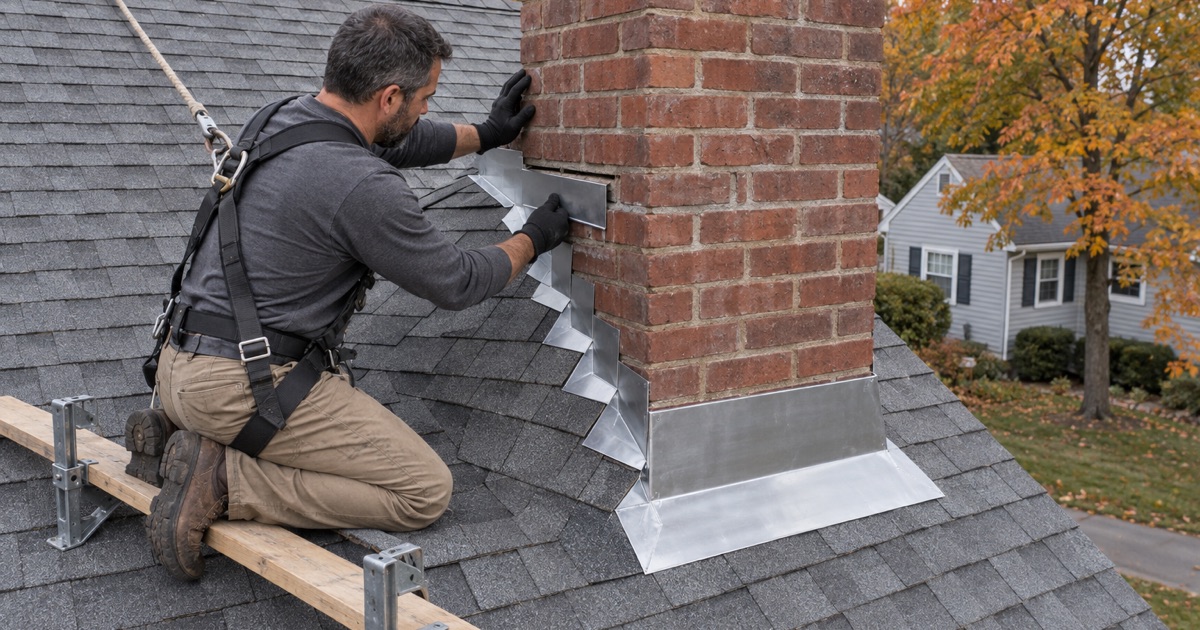
Step flashing is a series of L-shaped metal pieces, one for each course of shingles, that run up the sides of the chimney. Each piece laps over the one below it and is covered by the next shingle, so water stepping down the roof is turned away from the joint between the chimney and the deck.
On older houses, step flashing is often missing entirely, replaced with a strip of continuous metal and sealant, or rusted through after decades. We remove the shingles around the chimney, install new step flashing course by course and relay the shingles over it.
Counter Flashing Set Into the Mortar
Counter flashing covers the top edge of the step flashing and is set into a reglet, a groove cut into the mortar joints of the chimney. Done properly, it lets the roof and the chimney move independently while still shedding water, because the counter flashing overlaps the step flashing without being fastened to it.
The most common shortcut we find is counter flashing face-nailed to the brick and smeared with caulk. That holds for a season or two before the sealant cracks. We cut a proper reglet, set new counter flashing into it and seal the joint with a compatible mortar or sealant made for masonry.
Apron Flashing at the Front
On the downhill side of the chimney, apron flashing runs across the front face and laps over the shingles below. It carries water that has run down the face of the chimney back onto the roof surface. A bent, short or missing apron lets that water run under the shingles at the base of the chimney, which is where many slow leaks begin.
Crickets Behind Wide Chimneys
The uphill side of a chimney is where water, snow and leaves pile up. A cricket, sometimes called a saddle, is a small peaked roof built behind the chimney that splits that flow and sends it around both sides.
The International Residential Code requires a cricket behind any chimney wider than 30 inches, measured across the slope of the roof. Many older houses were built without one, and the back of those chimneys is often soaked after every storm. We frame the cricket, sheath it, and flash and shingle it into the roof, or cover it in metal where that suits the roof better.
Adding a cricket is easiest during a roof replacement, when the shingles around the chimney are already off. It can also be added on its own as a targeted repair when the rest of the roof still has life in it.
Crowns, Caps and Masonry
Chimney Crowns
The crown is the slab at the top of the chimney that surrounds the flue and sheds water off the masonry. Many crowns are built from ordinary mortar rather than a proper concrete mix, and they crack after repeated freeze and thaw cycles. Water then soaks straight down into the brick.
Small cracks can be sealed with a crown repair coating. Badly cracked or crumbling crowns are rebuilt with an overhang that drips water clear of the chimney face.
Caps and Chase Covers
A chimney cap covers the flue opening to keep out rain, snow, leaves and animals, and a screened cap stops sparks from landing on the roof. On framed chimneys, such as those boxed in with siding around a metal flue, the top is covered by a metal chase cover that can rust and let water into the chase.
Replacing a rusted chase cover or adding a cap to an open flue is one of the quickest ways to stop water from entering the chimney from above. Both are small jobs compared with the masonry and ceiling repairs that a few seasons of open-top leaks lead to.
Repointing and Brick Repair
Mortar joints wear out faster than brick, and once they open, rain is drawn into the masonry. Repointing means grinding out the failed mortar to a set depth and packing in new mortar that matches the original in strength and color.
Where bricks themselves have spalled or cracked, they are replaced. Repointing the section of chimney above the roofline, where weather hits hardest, is often enough to stop water that would otherwise run down into the attic.
Chimneys and Selling a Home
In Piscataway, a certificate of continued compliance is required when a home is sold or rented, and its checklist includes the condition of the chimney and flashing. A chimney with rusted flashing or loose masonry is something to address before listing rather than during the sale.
For sellers, we can repair the flashing and masonry and include the work in the written roof condition report you hand to the buyer’s inspector. That keeps a chimney question from turning into a late credit at closing.
- 20+ Years Roofing
- Itemized Written Estimates
- Attic-to-Ridge Leak Tracing