Piscataway Roofing brings more than 20 years in the trade to roofing in Clark, and this page is written for a particular kind of Clark owner: the one who does not live under the roof in question. Some own a single rental, some own the house they grew up in, and some rent out one floor while living on the other. Each of those owners needs a different conversation about a leak or a replacement.
Our approach starts the same way on every call. We look in the attic as well as on the roof, so the water is followed to the spot where it actually gets in, and we tell you plainly whether the roof can be repaired before anyone mentions replacing it. Only then do we write a price.
For landlords, we add one more step. Repairs are booked around the tenants’ schedules, and photos go to the owner after every visit, so the person paying for the work sees what the person living with it sees. The sections below cover how that plays out on a two-family house, from township registration to the re-roof itself.
Two-Family Houses in Clark: One Roof, Two Households
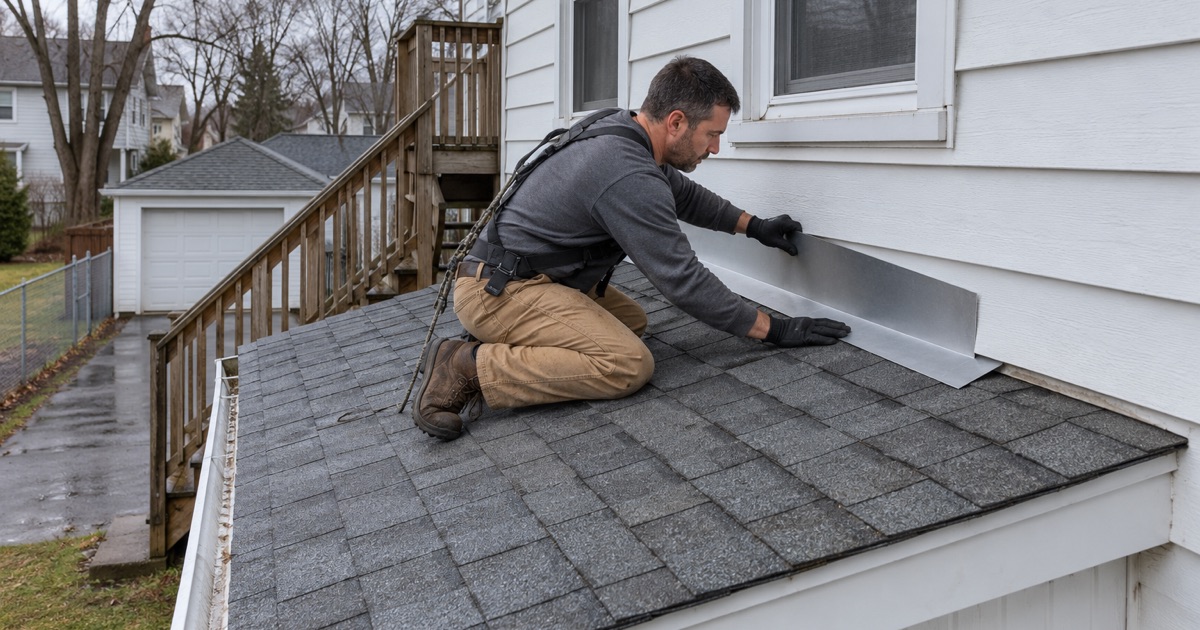
Clark is mostly a town of owner-occupied detached houses, but the two-family house is a distinct group inside that picture. The American Community Survey five-year estimates for 2024 count 336 units in two-unit buildings, about 5.5% of the township’s 6,055 housing units. Those are units rather than buildings, and a two-family house holds two of them.
Mostly Rented, Rarely Owner-Occupied
The same survey splits those units by who lives in them. It counts 261 as renter-occupied and only 32 as owner-occupied, with the rest falling outside both counts. In plain terms, when we pull up to a two-family house in Clark, the odds favor a tenant answering the door rather than the owner.
Outside detached houses and the larger apartment buildings, two-unit buildings hold more of the township’s renters than any other building type. Owning one usually means being a landlord with two households under a single roof.
One Roof, Two Sets of Concerns
A two-family house has one roof covering both units, whether the layout is side by side or one floor over the other. A leak over the upstairs bedroom and worn shingles over the downstairs porch are the same project, paid for by the same owner. What changes is how many people are affected while the work is done and who needs to be told about it.
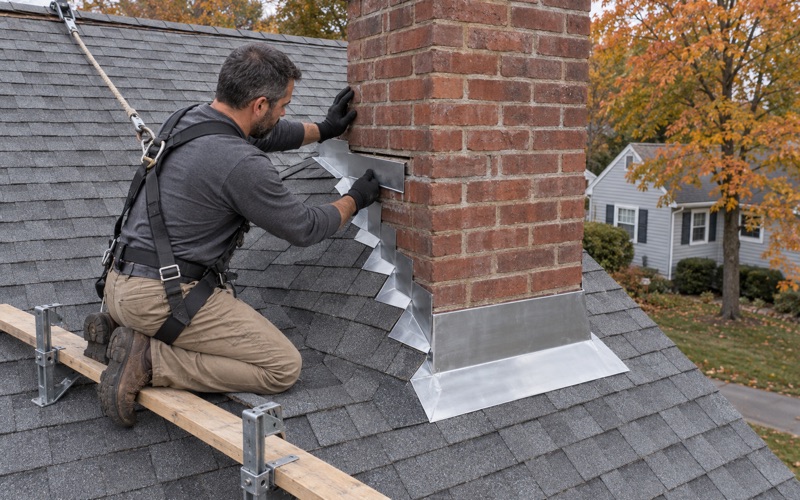
Shared features add to the coordination. A single chimney may serve both units, and a valley or dormer above one apartment can drain across the other side of the house. We note those details on the first visit, so the owner knows which unit’s ceiling is at risk from which part of the roof.
Most owners of these buildings did not buy them to manage roofing projects. They bought an income property, and the roof is one of the bigger costs it carries. We write our advice with that in mind, separating what has to be fixed now from what can be planned for a later season.
Looking for roofing closer to Berkeley Heights? See Roofing in Berkeley Heights.
Registering a Clark Rental With the Construction Code Official
Clark adopted its landlord registration ordinance, Ordinance 22-08, on August 1, 2022, and amended it in 2023 with Ordinance 23-27. It requires the owner of a single-family, two-family or multiple rental dwelling in the township to register that dwelling. Registration is filed with the Construction Code Official, on the township’s prescribed form, through its GovPilot portal.
The filing was due by the ordinance’s effective date for existing rentals, and it falls due when an owner takes title to a new one. A buyer picking up a two-family house in Clark as an investment should expect that registration as part of taking over the building.
Owner-Occupied Versus Absentee Owners
State law draws its own line through the two-family house. Under New Jersey’s Landlord Identity Law, an owner who lives in one unit of a two-unit building is not treated as a landlord for that law’s registration statement. An owner who lives elsewhere files that statement with the municipal clerk, while larger buildings governed by the Hotel and Multiple Dwelling Law file with the state’s Bureau of Housing Inspection instead.
Clark’s own ordinance is a separate requirement, so an owner should read the township rule and the state statute on their own terms rather than assuming one answers the other. For roofing, the distinction matters because it tells us who we will be dealing with. An owner on the first floor hears the drip the night it starts, while an absentee owner may learn about it from a tenant’s message days later.
What Registration Does Not Look At
Clark’s ordinance pairs registration with a $125 per-unit inspection, and it lets an owner hire a lead evaluation contractor certified by the state Department of Community Affairs instead. That reads as the rental lead-paint inspection, and nothing we have seen in the ordinance describes it as a look at the roof. A registered rental can still have a roof that needs attention, so registration is not a sign that anyone checked the shingles.
When the Tenant Sees the Leak and the Owner Decides the Roof
On a rented two-family house, the person who notices a leak is rarely the person who pays to fix it. A tenant sees the stain, the owner decides the repair, and the roofer has to work between the two. Getting that relay right is much of what separates a quick repair from a ceiling that keeps getting worse.
Starting From Someone Else’s Description
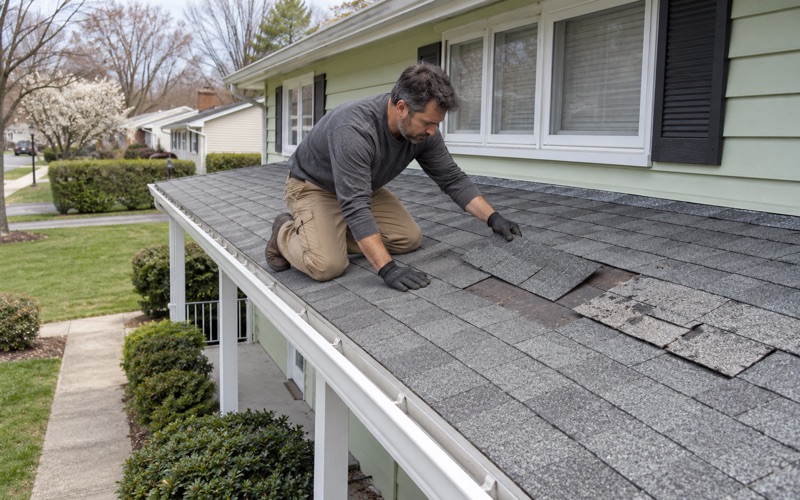
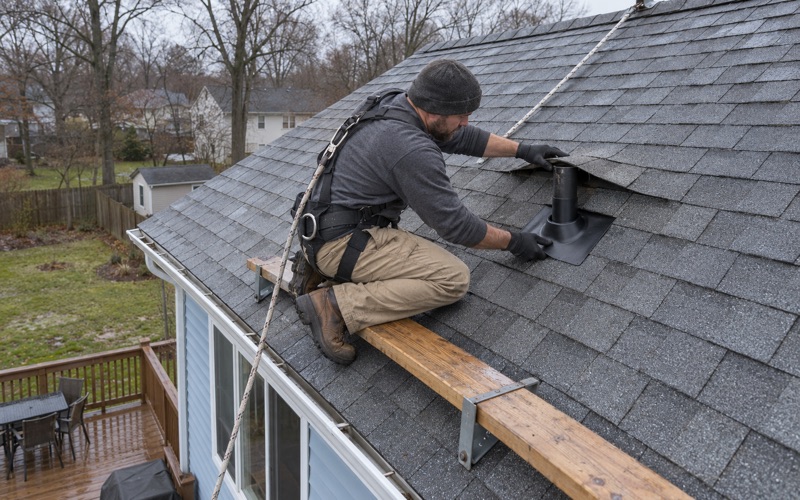
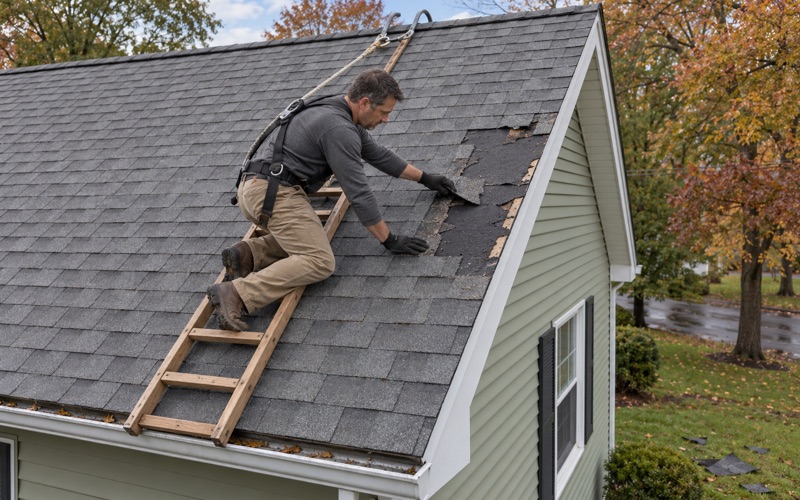
Leak reports that arrive secondhand tend to lose detail along the way. Water in the bedroom might mean a soaked ceiling under a cracked pipe boot, condensation dripping from an attic with poor airflow, or a gap at the chimney flashing that only shows in wind-driven rain. On every leak call we go into the attic as well as onto the roof, so the source is found rather than guessed from a tenant’s text.
With the owner’s permission, we also speak to the tenant directly. A five-minute call about when the stain appears, and whether it follows rain, wind or melting snow, narrows the search before anyone climbs a ladder.
Keeping Both Households and the Owner Informed
Two households under one roof means two sets of schedules, belongings and parked cars. We book repair visits around the tenants, and after each visit the owner receives photos of what we found and what we did. The landlord sees the same flashing, the same stained decking and the same finished work that the tenants live under.
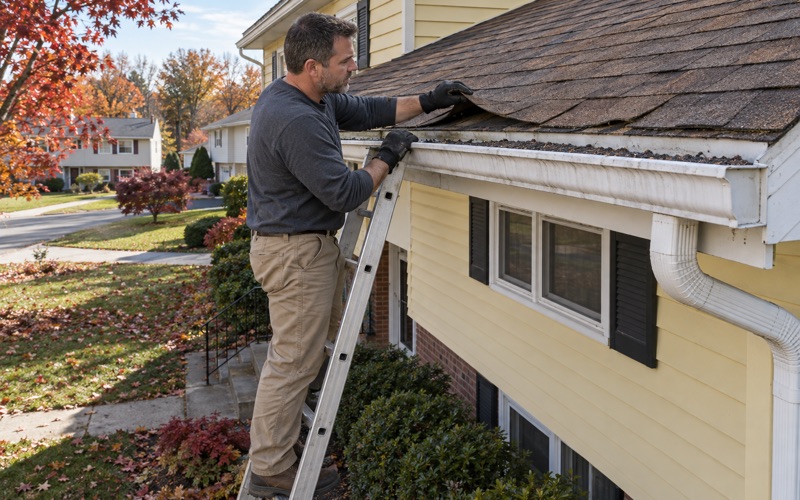
At the end of each workday we clean the driveway, yard and gutters, including a magnet sweep for roofing nails. On a rental, that protects the tenants’ tires and bare feet as much as the owner’s property.
Repair or Replace, Answered Plainly
Owners making decisions from a distance need a straight answer. We say whether the roof can be repaired before we raise replacement, and when a repair is enough we price it as a repair. When it is not, the owner gets the reasons in writing along with the photos that back them up.
An honest repair price is also easier for a landlord to plan around. Fixing a failed boot or a short run of flashing now can buy time to schedule a full replacement during a vacancy or a season that suits the building.
When a storm is the cause, we photograph and write up the damage for the owner’s own insurance claim. If asked, our crew will meet the adjuster at the house, which can save an absentee landlord a trip.
Re-Roofing a Two-Family House Under the One- and Two-Family Rule
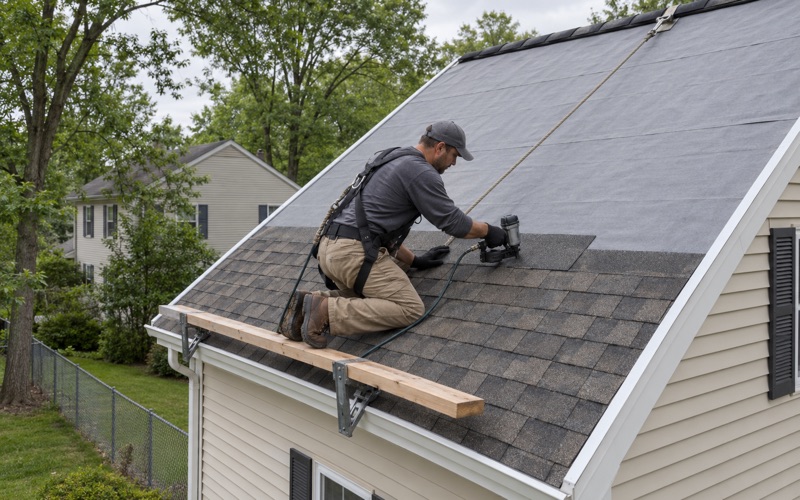
When replacement is the right answer, a two-family house in Clark is treated like a detached single-family home as far as the roof covering goes. New Jersey’s construction code lists repair or replacement of existing roof covering on detached one- and two-family dwellings as ordinary maintenance, which needs no permit. That keeps the paperwork light for a landlord planning a re-roof between leases or with tenants in place.
Tenants in place do not stop a re-roof, but they shape it. We set the start date with the owner, give the tenants notice of the work days, and plan each day’s tear-off so neither unit is left open to the weather overnight.
Where the Rule Stops
The rule covers detached one- and two-family dwellings only. An attached unit, or a building with three or more units, falls outside it, so an owner with several properties should not assume every one is handled the same way. We confirm the building type before we write the scope.
A Scope Two Estimates Can Be Measured Against
Our written scopes list tear-off, decking, underlayment, flashing, ventilation and gutters as separate lines. A landlord collecting quotes can set them side by side and see where one bid leaves something out. If damaged decking turns up once the old roof is off, we photograph it and show the owner before replacing it, at a per-sheet price already set in the contract.
Step, counter and chimney flashing are replaced with the roof rather than reused under new shingles, and attic ventilation is checked on every replacement, because a roof that cannot breathe ages from underneath. Gutters and leaders are sized and pitched along with the roof so water leaves the house instead of collecting at the foundation. On a two-family house, where each unit may have its own entry and its own downspouts, that drainage plan covers both sides.
Contracts, Painted Trim and a Future Sale
Every contract is written to New Jersey’s home improvement rules, including notice of the three-business-day right to cancel. Where painted fascia or trim on a home built before 1978 will be disturbed, the EPA’s lead-safe renovation rule applies to that part of the work. If the owner later decides to sell, we can provide a written roof condition report the seller can hand to the buyer’s inspector.
Clark Township sits in southern Union County, with the Garden State Parkway running north to south through it. Whether your two-family house is a rental you manage from across the state or the building you live in, call us before the next storm turns a tenant’s ceiling stain into a bigger repair.
- 20+ Years Roofing
- Itemized Written Estimates
- Attic-to-Ridge Leak Tracing