Piscataway Roofing handles commercial roofing in Piscataway, NJ, serving surrounding cities including Middlesex, Highland Park, Bound Brook, Metuchen and Manville. For more than 20 years we have repaired, inspected and replaced low-slope roofs on offices, retail centers, apartment and mixed-use buildings, churches, schools and light industrial buildings. Every commercial job starts with a close look at how the roof drains and what is sitting on it, because those two things decide most of what goes wrong.
Commercial roofs fail differently from house roofs. Water rarely comes through the middle of a field of membrane; it gets in at open seams, around rooftop units, at parapet walls and at drains that cannot keep up. A repair or replacement that does not address those details looks good for a season and then leaks in the same places.
Commercial roofs in New Jersey are also permit work. The state’s ordinary-maintenance exemption applies only to roof coverings on detached one- and two-family houses, so commercial, apartment and mixed-use replacements go through the local construction office, and our scopes are written with that in mind.
Commercial Roof Systems We Install and Repair
TPO and PVC Single-Ply Membranes
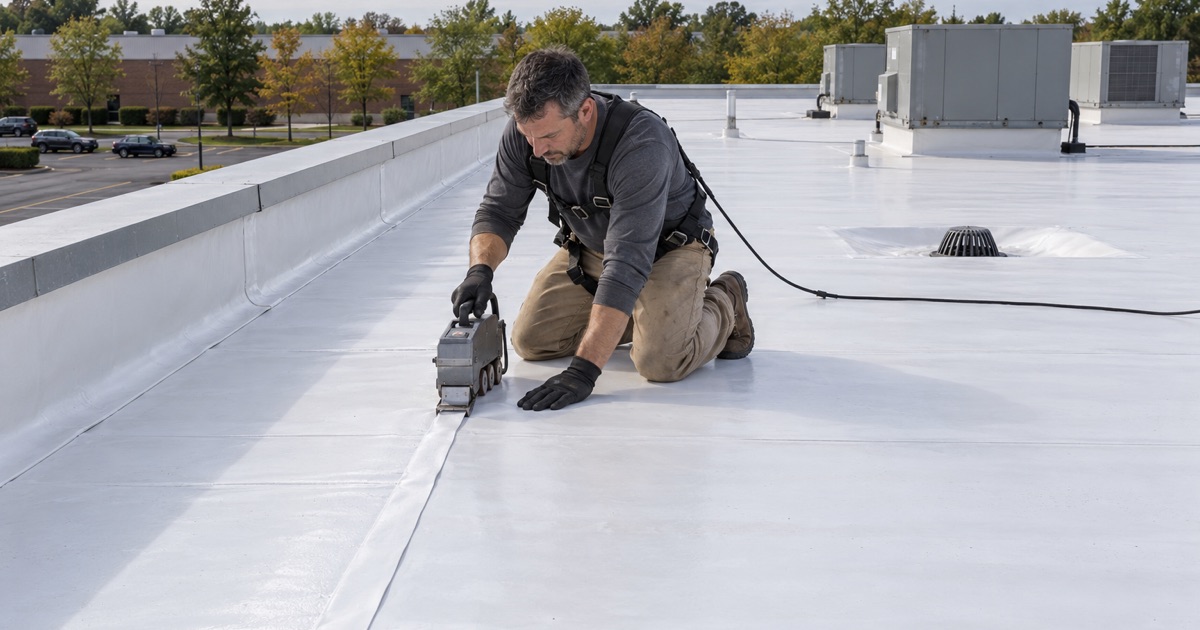
TPO and PVC membranes are rolled out in wide sheets and joined with hot-air welded seams that become as strong as the sheet itself. Their white or light surfaces reflect sunlight, which lowers roof temperatures in summer and can ease cooling loads on the floors below.
PVC holds up particularly well where grease, oils or chemicals reach the roof, such as above restaurant exhaust fans. TPO is a common, cost-effective choice for offices, retail buildings and warehouses. Both are repaired by welding new membrane onto clean, prepared old membrane.
EPDM Rubber Roofs
EPDM is a synthetic rubber membrane installed in very large sheets, which means fewer seams across the roof. It stays flexible in cold weather and has a long track record on low-slope commercial buildings and apartment roofs.
EPDM seams are joined with primer and seam tape, and most EPDM leaks we see are at seams, at flashings around curbs and walls, or from punctures. Those are repaired with cleaned, primed patches that bond to the existing rubber.
Torch-Down Modified Bitumen
Modified bitumen in SBS or APP formulations is applied in layers, often heat-welded with a torch, to build a thick roof that resists foot traffic and punctures. It is common on older commercial buildings, apartment buildings and roofs with heavy maintenance traffic.
Blisters, split seams and cracked flashings are its usual failures. We repair them by cutting out the damaged area and welding new layers over it with generous overlaps onto sound material.
Drainage, Insulation and Rooftop Equipment
Drains, Scuppers and Ponding Water
Water that sits on a roof for days after rain stresses every seam and adds weight to the structure. Ponding usually traces to clogged drains, scuppers set too high, sagging decks or insulation that has compressed over time.
During a replacement, tapered insulation can be added to pitch water toward the drains, and new drain bodies and scuppers are flashed into the membrane. During repairs, clearing drains and correcting low spots often does as much good as patching the leak itself.
Recover or Full Tear-Off
Some commercial roofs can be recovered, with a new membrane installed over the existing roof and a cover board between them, which avoids the cost and disruption of a full tear-off. That only works when the existing roof is dry, firmly attached and limited to the number of layers the code allows.
Where the old roof is wet, loose or already layered, a full tear-off down to the deck is the only sound option. We explain which one your building qualifies for and show the core samples behind that answer.
Wet Insulation and Core Testing
A leak on a flat roof often soaks a wide area of insulation before it shows up inside. Wet insulation loses much of its value, adds weight and keeps feeding moisture to the deck even after the membrane is patched.
We take core samples where the roof looks or feels suspect, so the decision between repair, recover and full replacement is based on what is actually under the membrane. That keeps owners from paying to coat a roof that is waterlogged underneath.
HVAC Units, Curbs and Penetrations
Rooftop HVAC units, exhaust fans, conduit runs and pipe supports all pass through or sit on the roof, and each one is a leak point. Service technicians walking to and from equipment also puncture membranes, especially around the units themselves.
We reflash curbs and pitch pans, add walkway pads on the paths technicians use, and note equipment-related damage in our reports so the property manager can address it with the right party.
Commercial Roofing in the Piscataway Area
Piscataway’s commercial stock runs from older strip retail and office buildings to very large modern distribution buildings along Centennial Avenue and Constitution Avenue, some completed as recently as 2019 and 2024. Buildings of that kind carry low-slope membrane roofs as a class, and their drainage, insulation and equipment layouts differ widely from those on an older retail roof.
Apartment and mixed-use buildings are another large share of the local stock. Buildings with three or more units fall under New Jersey’s multiple dwelling maintenance code, which expects roofs and leaders to be kept watertight, so we document inspections and repairs for owners and send photos after each visit.
For occupied buildings, we phase work so tenants can keep operating. Each section is made watertight before the crew leaves for the day, entrances and loading areas are protected, and the site is cleaned daily, including a magnet sweep for fasteners in parking areas.
- 20+ Years Roofing
- Itemized Written Estimates
- Attic-to-Ridge Leak Tracing