Piscataway Roofing brings more than 20 years of experience to roofing in Hanover, and on this page we focus on the buildings that change the work most here: big, flat commercial roofs over warehouse, flex and office space. A roof that covers a loading floor or a leased suite does not get handled like a shingled house. The decisions sit with an owner, a property manager or a tenant, and the schedule has to work around trucks and people who are still inside.
Our approach on those roofs starts the same way it does on any leak. We trace the water from the inside as well as from the roof surface, so the spot where it actually enters is found before anyone talks about price. Then we tell the owner plainly whether a repair will hold or whether the membrane has reached the point where a re-roof makes more sense.
When a re-roof is the answer, the written scope breaks the job into separate lines for tear-off, deck repair, insulation and underlayment, flashing, edge metal and drainage. That lets a building owner or an asset manager set two proposals side by side and compare them line by line. Below we cover what is being built in the township, what a low-slope roof at this scale involves, and how the work is planned around an occupied building.
Whippany’s Industrial Land and the New Logistics Buildings
Hanover Township in Morris County has two main unincorporated communities, Whippany and Cedar Knolls, and every commercial building named on this page sits in the Whippany section. Industrial land there is being reworked. Older office space is giving way to warehouse, logistics and flex buildings, the kind with tall clear heights, dock doors and wide, nearly flat roofs.
A town that has weighed how much warehouse space it wants
The question of warehouse growth has been a live one here for years. At the December 2021 groundbreaking for the River Park town center, built on the former Whippany Paper Board site along the Whippany River, former Mayor John Ferramosca said, “The alternative could have been 470,000 square feet of warehouse space.” He added that it could have put significant trucking on Eden Lane, Whippany Road and South Jefferson Road.
That remark matters for roofing because it shows where the building stock is heading. The parcels that did go industrial are being filled with large single-story structures. Each one carries a roof whose care is a facilities decision rather than a household one.
35 South Jefferson Road: an office comes down, a logistics building goes up
Real Estate NJ reported in September 2025 that Marcus Partners plans a 72,000-square-foot logistics facility at 35 South Jefferson Road, on a 6.6-acre site. A vacant 40,000-square-foot office building there was slated for demolition, with site work underway. The new building was marketed with 36-foot clear ceiling heights and at least 10 dock doors, and delivery was slated for the third quarter of 2026.
The article did not describe the roof, and we have no role in the project. What a building of that type usually carries is a low-slope commercial roof assembly, and that is the general category we discuss on this page. Owners of the older buildings around it face the same family of roof decisions once their own membranes age.
Looking for roofing closer to Holmdel? See Holmdel Roofing.
The Apollo Drive Buildings and Their Large Flat Roofs
Apollo Drive shows the scale of Whippany’s commercial roofs as clearly as anywhere in the township. Two buildings there have changed hands in recent years, and both are well over 100,000 square feet of floor space. Neither sale report said anything about the roof, so what follows is about the roof type such buildings generally have, not about any one building.
1 Apollo Drive and 4 Apollo Drive
Number 1 Apollo Drive is a 125,234-square-foot flex warehouse and office building on 12.77 acres, reported by Real Estate NJ in June 2023 as 48 percent occupied when it sold. Number 4 Apollo Drive is a 127,144-square-foot single-tenant flight training facility on a 16.8-acre parcel. JLL reported in October 2023 that it was built in 2006, expanded in 2008 and renovated in 2020, with clear heights over 38 feet.
Those two show the range of users under one kind of roof. A partly leased flex building has several tenants with different hours and different tolerance for disruption. A single-tenant training facility has one occupant whose operation cannot simply stop for a roof crew.
What a low-slope roof at this scale involves
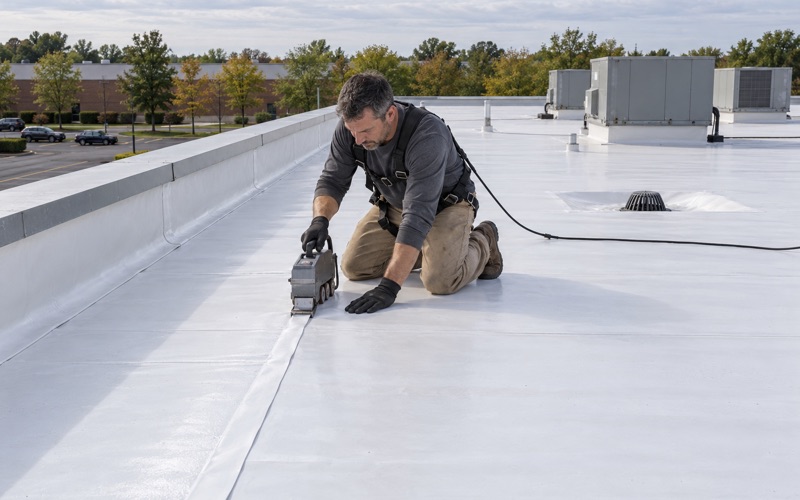
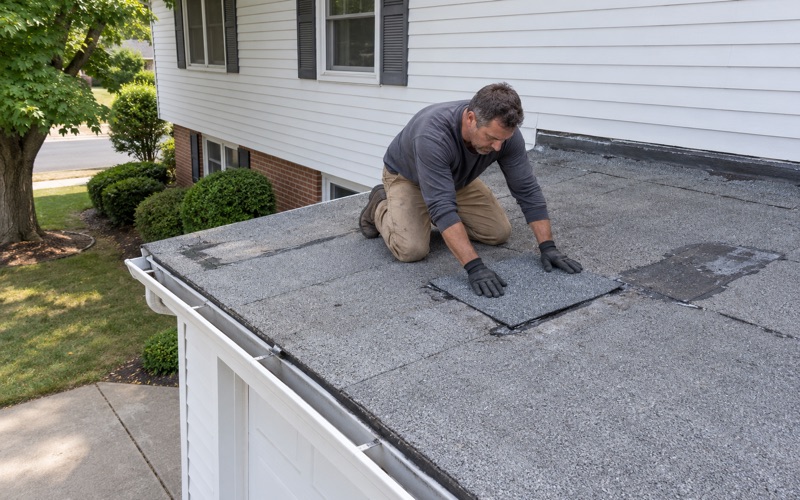
Buildings with clear heights in the high thirties generally sit under low-slope roofs covered with a membrane rather than shingles. Across the industry the common choices are single-ply TPO or PVC, EPDM rubber, and SBS or APP modified bitumen, each with its own seam method and its own way of failing. We do not assume which one a given Whippany building has; we look first.
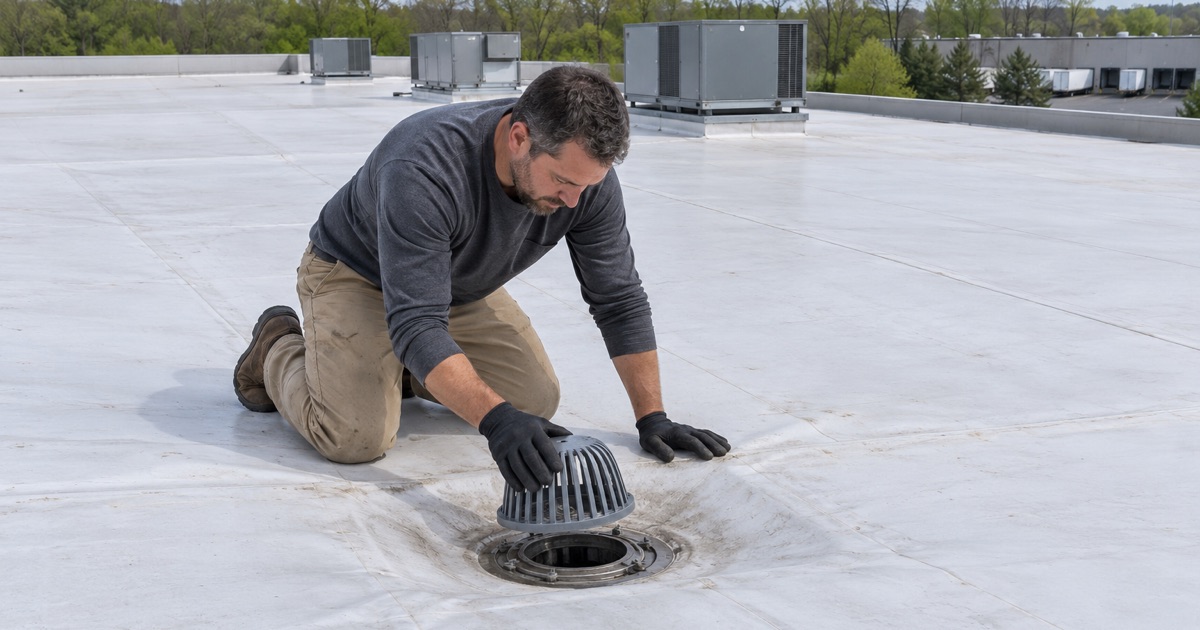
On a roof that size, the trouble spots are usually not the open field of membrane. They are the perimeter edge metal, the curbs around rooftop units, the pipe penetrations, the drains and scuppers, and any spot where an addition meets the original structure. An expanded building in particular has a joint between old and new roof sections, and that seam deserves a close look on every inspection.
Ponding, drainage and insulation
Low-slope does not mean no slope, and water that sits in one place for days speeds up wear on any membrane. We check how water moves toward drains, whether tapered insulation or crickets are doing their job, and whether wet insulation is hiding under a surface that looks sound. Wet insulation has to be found and cut out before new material goes over it, or the new roof starts with a problem underneath.
Commercial Low-Slope Re-Roofs Are Permit Work
One point confuses owners who have also replaced a roof at home. New Jersey’s ordinary-maintenance rule lets roof covering be replaced on a detached one- or two-family dwelling without a construction permit. That rule covers those houses only, and a warehouse, flex building or office is outside it.
Where the house rule stops
A re-roof on a commercial building is construction permit work in New Jersey, so it runs through the local construction office rather than going ahead as routine upkeep. The same boundary applies in Hanover’s attached and multifamily housing, which falls outside the detached-house rule as well. We sort out which side of that line a building sits on before the scope is written, so nobody is surprised once the job is booked.
For property in the township, the office that handles construction permits is Hanover Township Building & Zoning at 1000 Route 10 in Whippany. The township’s page lists Sean Donlon as Construction Code Official and Zoning Officer, at 973-428-2462. It does not publish a stance on re-roofing, so the owner’s application and any questions about inspections go through that office directly.
What the owner decides
On these buildings the people choosing the work are owners, asset managers and sometimes tenants whose leases put the roof on them. We write the scope so each of them can see what is being priced. Tear-off, deck repair, insulation, membrane, flashing, edge metal and drainage each get their own line, which makes a competing bid easy to compare.
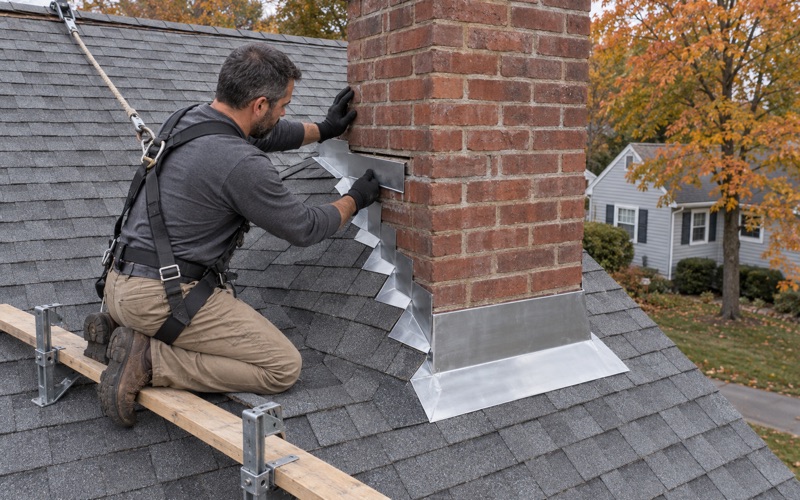
If damaged decking turns up once the old roof is off, we photograph it and show it to the owner before replacing it, at a unit price set in the contract. Flashing at walls, curbs and parapets is replaced as part of the new roof rather than reused. Old flashing under a new membrane tends to be where the next leak starts.
Storm damage on a flat roof
Wind can lift membrane edges and flashing on a big roof without anything looking wrong from the parking lot. After a storm we photograph what we find and write it up for the owner’s own claim. When the owner asks, we will meet the insurance adjuster on the roof and walk the damage together.
Scheduling Roof Work Around Dock Doors and Tenants
A warehouse or flex building rarely empties out for a roof job. Trucks still need the dock doors, and office tenants still need the parking lot and the front entrance. Planning that around the work is a big part of doing a commercial re-roof well, and it starts well before the first crew arrives.
Staging, deliveries and the loading area
Material deliveries, the hoist location and the dumpster all compete for the same pavement as tractor-trailers. We set the staging area with the property manager so that dock doors stay usable, and we time deliveries to avoid the busiest shipping hours. On a building with at least 10 dock doors, losing even a few of them for a morning is a real cost to the tenant.
The site is cleaned at the end of each work day, and that includes a magnet sweep of the lot and the truck court. Roofing nails and fasteners in a loading area end up in tires. Keeping them off the pavement protects the tenant’s fleet as well as the owner’s relationship with that tenant.
Working over people who are inside
Tearing off a section of roof over an occupied suite means that section has to be closed back in the same day. We work in areas sized to what the crew can tear off and dry in before weather or nightfall. Tenants get advance notice of which part of the building will be over their heads and when.
Noise and vibration come with the tear-off, so we talk through quiet hours with the owner before the schedule is set. A partly leased flex building may also have vacant suites, which can make good starting points while the crew settles into the roof. Photos go to the owner after each visit, so a manager who is not on site still sees the progress.
Leaks while the building is in use
A leak over racked inventory or office ceiling tile cannot wait for a full re-roof decision. We trace it from inside the space and from above, find where the water actually enters, and make a repair that holds until the larger plan is settled. Then we tell the owner honestly whether the roof has years left or whether the patches are buying time.
That honest read is what most owners in Whippany’s industrial parks need first. Some roofs have plenty of life once a few details are fixed, and some are past saving. Either way, we put it in writing so the decision can be made with the full picture in front of everyone who has a stake in it.
- 20+ Years Roofing
- Itemized Written Estimates
- Attic-to-Ridge Leak Tracing