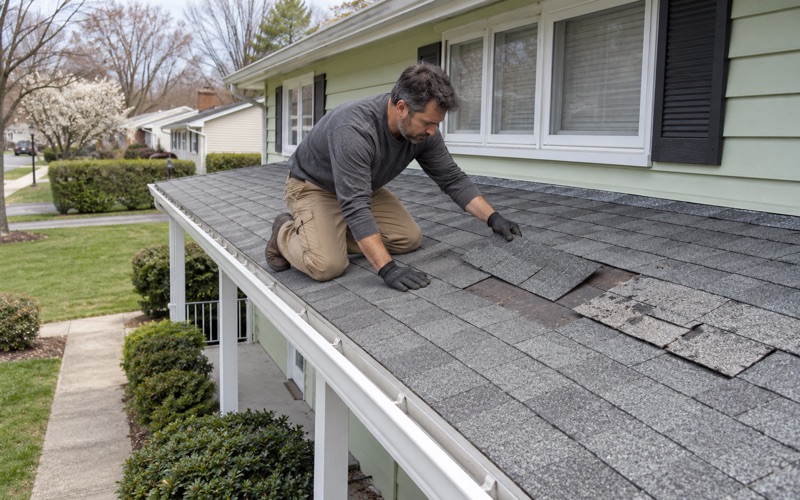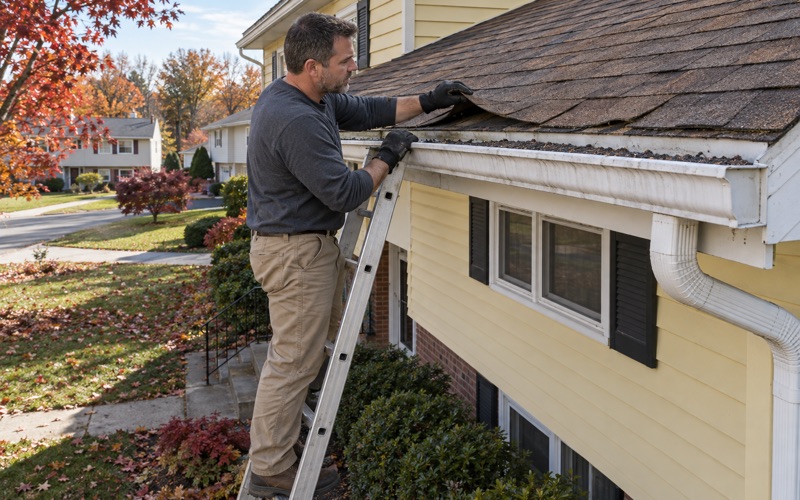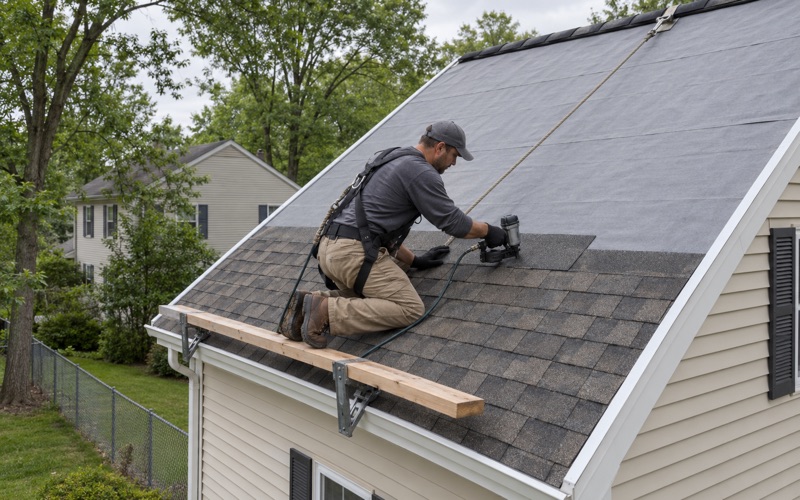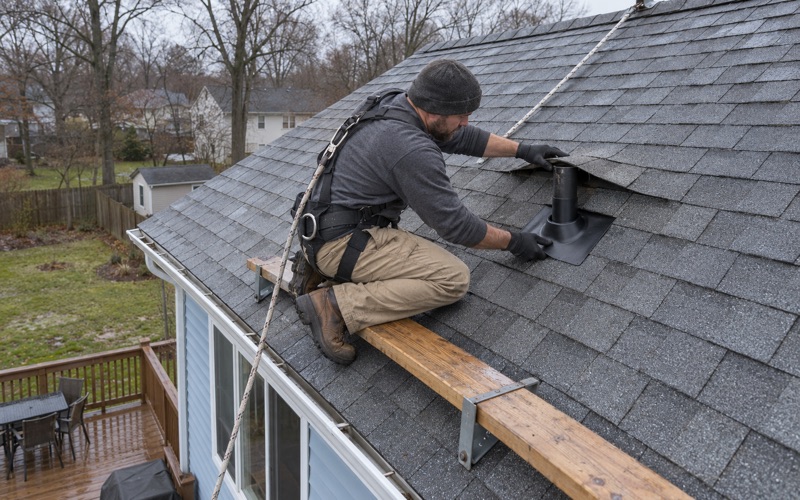
Piscataway Roofing has spent more than 20 years on roofing in Manville and the towns around our home base, and a Manville re-roof starts the same way any of ours does. We go into the attic as well as onto the roof, trace a leak to where the water actually enters, and tell you plainly whether a repair will hold before replacement comes up at all.
What sets this borough apart is less about the roof than about how the materials and equipment reach it. When a job calls for a crane or a tall boom lift, the height that equipment reaches can matter to federal aviation rules here, so we treat it as a planning question, settled before a delivery date is set rather than on the morning the truck arrives. Every estimate we write lists tear-off, decking, underlayment, flashing, ventilation and gutters on separate lines, so two bids can be set side by side and compared item by item.
Central Jersey Regional Airport and the FAA’s 100-to-1 Surface
Central Jersey Regional Airport, listed by the FAA under the identifier 47N, sits about a mile south of Manville in Hillsborough Township. It is privately owned but open to public use, with a single asphalt runway, 7/25, that measures 3,507 by 50 feet. Its surveyed field elevation is 85.9 feet, according to FAA data effective October 1, 2026. Manville itself, a Somerset County borough of 10,953 people at the 2020 census, covers 2.45 square miles directly to the north.
Why the Runway Length Matters
Federal rule 14 CFR 77.9 sets out when anyone planning construction or alteration has to notify the FAA. For an airport whose longest runway is more than 3,200 feet, notice is required for anything that would rise above an imaginary surface sloping upward at 100 to 1 from the nearest point of the runway, out to a horizontal distance of 20,000 feet. At 3,507 feet, the runway here clears that threshold.
The rule covers public-use airports listed in the FAA’s airport directory, and this one is open to the public despite its private ownership. The notice rule is measured from the runway, not from any municipal boundary, so the fact that the airport sits in Hillsborough Township rather than in Manville makes no difference to how a Manville address is evaluated. The 20,000-foot reach of the surface is close to four miles, far wider than the mile between the airport and the borough.
What 100 to 1 Looks Like on the Ground
A 100-to-1 slope climbs one foot for every 100 feet of horizontal distance. So the surface sits only a few feet above runway elevation close to the airport and rises gradually across the borough, and the clearance at any one spot depends on how far that spot is from the runway and how high the ground there sits. That is why no single height works as a rule of thumb for Manville, and why we never quote one.
A separate trigger in the same rule covers anything more than 200 feet above ground level, but a residential roofing job will rarely come near that. For a house in Manville, the 100-to-1 surface is the one worth checking.
Looking for roofing closer to Warren? See Warren Roofing.
Cranes, Boom Trucks and Boom Lifts Count as Temporary Construction
Part 77 is often read as a rule about towers and buildings, but airport and municipal guidance applies the same notice filing to equipment that is only on site for a day. San Jose’s policy lists any proposed temporary structure, such as construction equipment, that would exceed the 100-to-1 or 200-foot criteria. San Diego’s bulletin names temporary construction equipment, and DuPage Airport publishes a page devoted to filing for construction cranes.
Which Roofing Equipment Reaches Upward
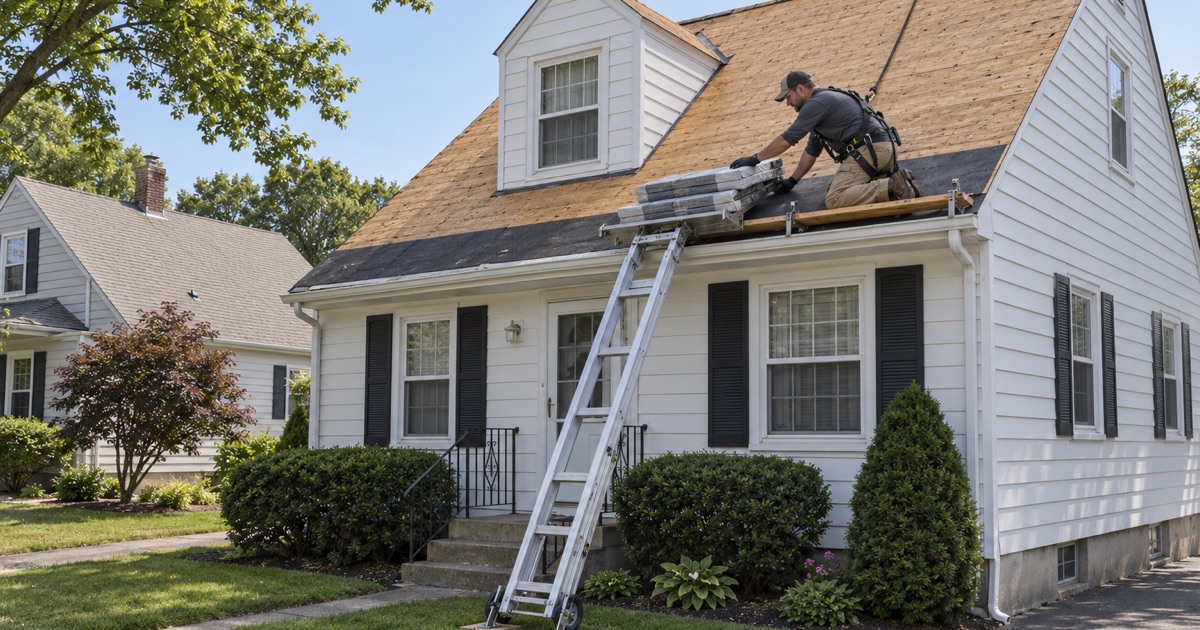
Most residential re-roofs are handled with ladders, a hoist or a conveyor, and none of those climbs far above the eaves. The equipment that does is a boom truck that lands bundles of shingles on the ridge, a crane that sets rolls of membrane on a low-slope roof, or a tall boom lift used where a ladder cannot be set safely. A boom extended above the roofline is taller than the house it serves, and that extra height is what the notice surface is measured against.
A boom lift is sometimes the safer way to reach a steep slope, a tall chimney or a third-story wall, and OSHA expects fall protection on residential roofing work at six feet. The lift’s working height at full extension is the number to compare against the notice surface, and equipment suppliers publish that figure for each machine.
Ground Elevation and Distance Change the Answer
Two houses with identical roofs can get different answers. One closer to the runway, or on ground higher than its neighbors, leaves less room under the surface than one farther north on lower ground. The equipment height that matters is the top of the boom at full reach, not the height of the house.
There is no borough-wide answer, and nothing we have seen shows a Manville roof job that has needed notice. The point is to find out for your own address before a crane is booked rather than assume either way.
Form 7460-1, the 45-Day Lead Time and the Shielding Exemption
When notice is required, it goes to the FAA on Form 7460-1, Notice of Proposed Construction or Alteration. Under 14 CFR 77.7 the form is due at least 45 days before the start date of the work. For a roof, the date that matters is the day the crane or boom truck would go up, not the day the contract is signed. After a filing the FAA reviews the proposal and issues a determination, and the 45-day lead time is there so that review can happen before the equipment goes up.
Who Handles the Filing
We do not file FAA notices and hold no airspace credential, so we will not tell you a lift is cleared. What we do is raise the question early, ask the crane or delivery supplier how high its equipment will reach on your job, and build the schedule so a 45-day wait, if it applies, does not land in the middle of a tear-off.
If your address does call for notice, that does not by itself stop the job. It changes the order of steps: the screening and any filing come first, then the delivery date, then the tear-off.
The FAA also offers an online Notice Criteria Tool that takes a location, the ground elevation and the height of a structure and reports whether notice is indicated. It is a screening step, and the person proposing the work is the one responsible for acting on its result.
When Nearby Buildings Shield the Lift
Section 77.9(e)(1) exempts an object that is shielded by existing structures of a permanent and substantial nature, or by terrain of equal or greater height, in a congested area. In a built-up neighborhood a boom that stays below the surrounding rooftops or a nearby taller building may fall under that exemption. Whether it does is a judgment about the specific site and the specific lift, so we treat it as a question to confirm rather than a shortcut to rely on.
The exemption is narrower than it sounds. It depends on the existing structure being permanent and substantial and on the area being congested, and a lone boom rising above every roof on the block is not shielded by any of them.
Planning Material Delivery for a Manville Re-Roof
Most of the planning on a Manville job is the same work we do anywhere, with the delivery question added at the front. Settling it at the estimate stage keeps a surprise from pushing back a start date that the household has already arranged around.
Choosing How Material Reaches the Roof
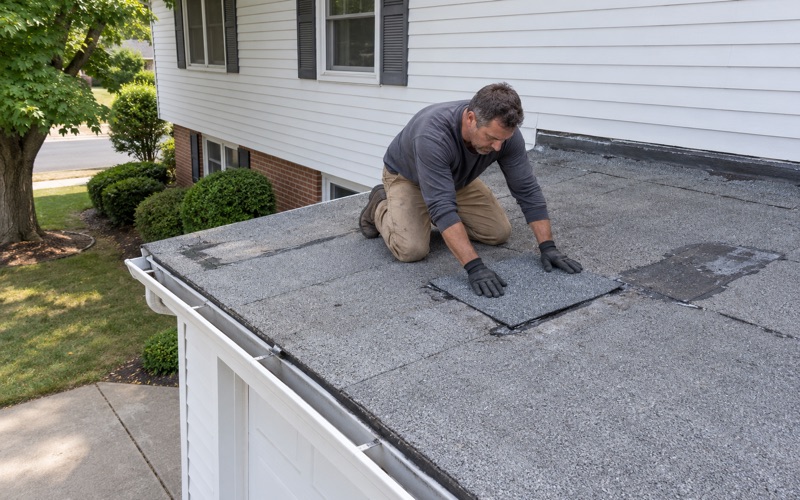
On a pitched roof with room in the driveway, shingles can often go up by ladder hoist or conveyor, with no boom involved and nothing to screen. Where a boom truck or crane makes more sense, because of weight, a long carry or a low-slope roof covered in membrane, we work out the equipment and its reach first. If notice turns out to be indicated, the delivery date moves to fit the 45 days instead of the other way around.
A delivery that depends on a boom also depends on where the truck can stand. We look at the driveway, overhead wires and the street in front before choosing the method, because a truck that cannot set up close enough needs more reach, and a longer reach can mean a taller lift.
Keeping the Schedule Honest Once the Roof Is Open
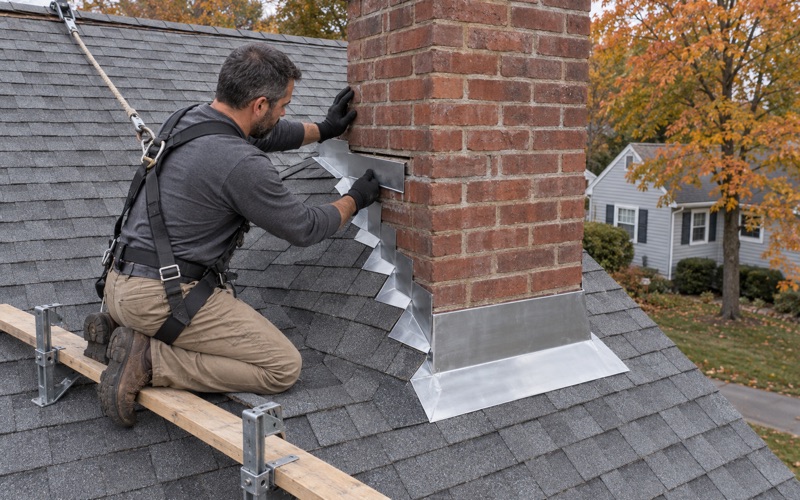
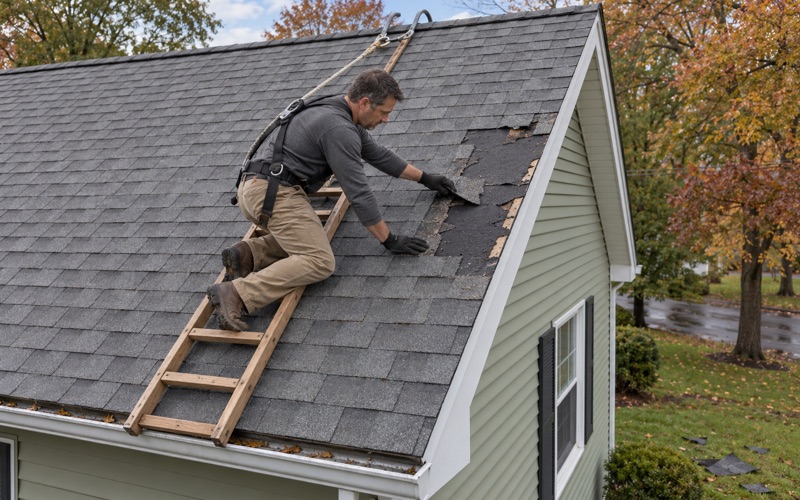
Once the old roof comes off, any damaged decking is photographed and shown to you before a sheet is replaced, at the per-sheet price written into the contract. Step, counter and chimney flashing is replaced with the new roof rather than reused under it, and attic ventilation is checked so the new shingles are not aging from underneath.
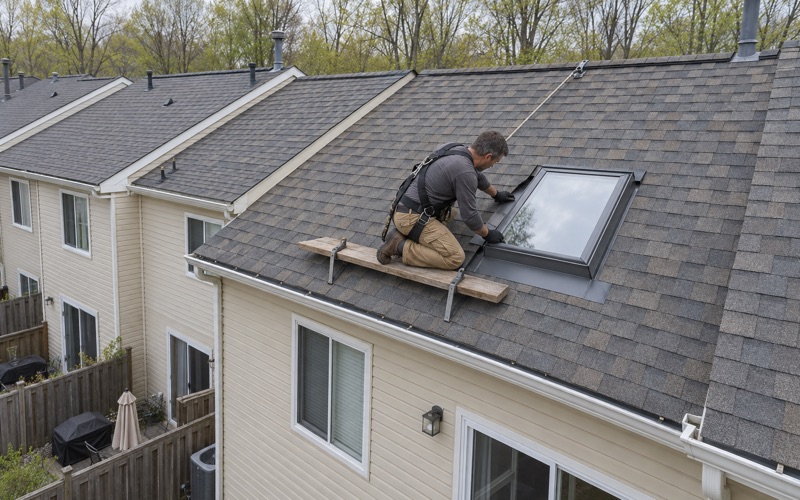
If solar panels sit on the roof, their removal and reinstall go into the schedule from the start, which matters more when a lift or crane date is already fixed. Gutters and leaders are sized and pitched along with the roof so the water clears the house and its foundation.
Contracts, Claims and Cleanup
Our contracts follow New Jersey’s home improvement rules, including the three-day cancellation notice, so the scope is in writing before anything is ordered. In a townhouse or condominium community, we check the association’s documents to see who holds the roof before we write an estimate. At the end of each work day the driveway, yard and gutters are cleaned and a magnet is run across the ground for roofing nails.
If a storm damages the roof, we photograph and write up the damage for your own claim and will meet the adjuster on site when you ask. A seller gets a written roof condition report to hand to the buyer’s inspector.
- 20+ Years Roofing
- Itemized Written Estimates
- Attic-to-Ridge Leak Tracing