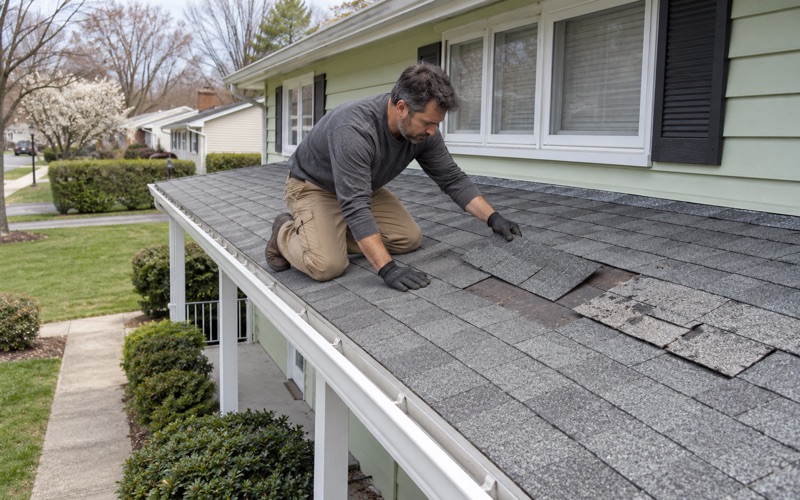
Piscataway Roofing has handled roofing in Metuchen and the surrounding part of Middlesex County for more than 20 years, and much of what we do here is shaped by one fact: a lot of our customers are not home on weekdays. We repair leaks, replace worn roofs, rebuild flashing and size gutters, and we plan each of those jobs around the hours an owner can actually be reached.
Every leak call starts in the attic as well as on the shingles, because the stain on a ceiling is rarely directly below the spot where water gets in. Once we know where it enters, we tell you plainly whether a repair will hold before anyone talks about a new roof.
When replacement is the right call, our written scope breaks the job into tear-off, decking, underlayment, flashing, ventilation and gutters as separate lines. That makes it easy to set our number beside another contractor’s and see exactly where they differ.
A Transit Village on the Northeast Corridor
Metuchen is a train borough. The New Jersey Department of Transportation designated it a New Jersey Transit Village in 2003, and its station sits on the Northeast Corridor, the main rail line between New York and Philadelphia. A 2015 NJTOD report described Metuchen as the ninth busiest outlying station in the NJ TRANSIT system at the time, with more than 3,700 weekday boardings that year and more than 50 trains a day to Newark Penn.
The same report put the average ride to New York Penn Station at 52 minutes, or 43 minutes on an express. Newark Penn was about 30 minutes away. For a household on that schedule, a weekday morning starts early and ends late, and that is the window a roofing crew has to work inside.
How many Metuchen workers ride the train
The Census Bureau’s American Community Survey (2024 five-year estimates) counts 7,582 workers living in the borough. Of those, 955 commute by long-distance train or commuter rail, about 12.6 percent, with a margin of error of 193. Counting buses, subway and light rail as well, 1,189 use public transportation of some kind.
Another 2,042 residents, roughly 26.9 percent, work from home. So on any given weekday a Metuchen street holds two kinds of owners: the ones who leave for the station before 7:00 a.m. and the ones who are home all day on video calls. Both need roof work planned differently, and we ask which one you are before we set a date.
Detached houses and owner-occupied streets
Away from the station, most of Metuchen stays residential and owner-occupied. The ACS counts 74.6 percent of occupied units as owner-occupied and 66.4 percent of housing units as one-unit detached houses. On those homes, replacing the roof covering counts as ordinary maintenance under New Jersey’s Uniform Construction Code (N.J.A.C. 5:23-2.7), so no construction permit is needed for a like-for-like shingle replacement on a detached one- or two-family house.
That changes when the work goes past the covering. Cutting or removing a rafter, beam or other bearing support falls outside ordinary maintenance, and so does work on attached townhouses or larger buildings. If we open a roof and find something structural, we stop, show you, and explain what the Metuchen Construction Code Enforcement Office at 500 Main Street would need to see before we go further.
Looking for roofing closer to Manville? See Roofing Services in Manville.
Pearl Street, Woodmont Metro and the Roofs by the Station
The area closest to the tracks looks different from the rest of the borough. The Pearl Street redevelopment, under way in 2015, replaced a five-acre, 670-space surface lot beside the station with a parking garage, ground-floor retail and Woodmont Metro at Metuchen Station, 273 one- and two-bedroom apartments in two buildings. The west building holds 162 units and the east building 111, and the first phase opened for leasing in the fall of 2016. The complex includes a rooftop terrace for residents.
We have not worked on Woodmont Metro, and we make no claim about its roof. We mention it because it marks where Metuchen’s housing splits. A multifamily building with a resident roof deck sits outside the detached one- and two-family wording of the ordinary maintenance rule, and roofs of that size usually carry low-slope membranes rather than shingles.
Low-slope roofs near the station
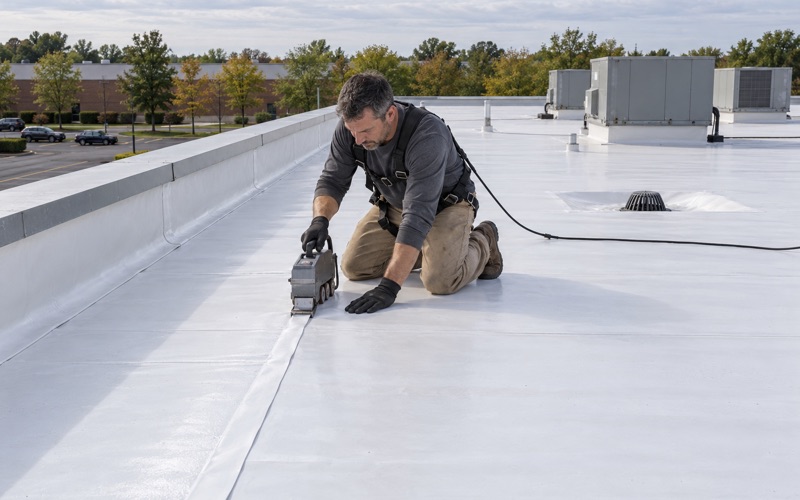
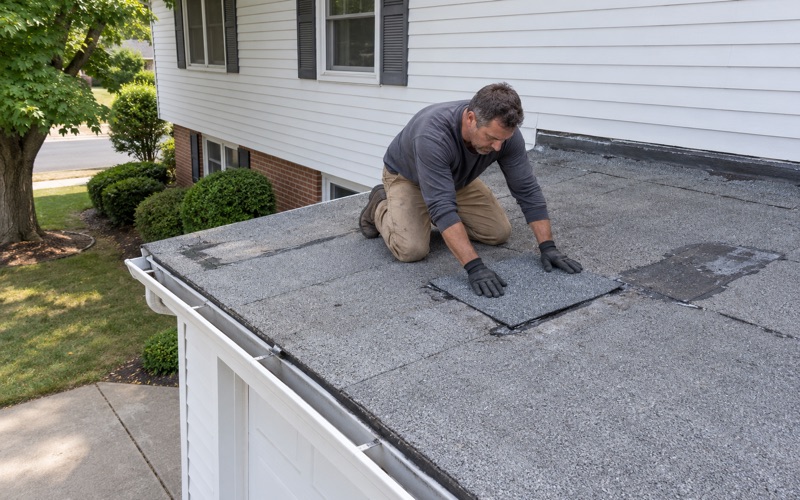
On the commercial and mixed-use blocks around Main Street and the station, flat and low-slope roofs are common. We work with TPO and PVC single-ply membranes, EPDM rubber, and torch-down SBS and APP modified bitumen, and the right choice depends on what is already there, how the roof drains and what sits on top of it.
A roof deck, a rooftop mechanical unit or a run of pipes through the membrane all add places for water to get in. On these roofs we spend as much time on the edges, curbs and penetrations as on the field of the membrane, because that is where most low-slope leaks begin.
Townhouses and association roofs
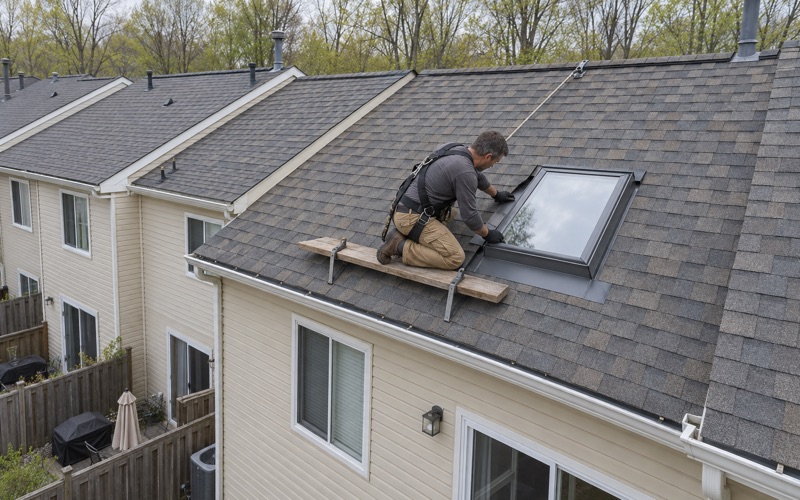
The ACS counts 626 attached single-family units in Metuchen. In a townhouse or condominium community, the roof may belong to the owner, the association or both, depending on the governing documents. Before we write any estimate, we check who holds the roof against the association’s documents, so you are not paying to fix something the association is responsible for, or the reverse.
Planning Roof Work Around a Weekday Commute
A roof replacement on a detached Metuchen house is usually a one- to three-day job, depending on size, layers and what the decking looks like once the old shingles come off. For a household that is gone on a 52-minute ride each way, the question is less about how long the crew is on the roof and more about which days, and who needs to be home for which part.
We set that plan before the contract is signed. You know the tear-off day, the dry-in day and the finish day in advance, and you know which of those, if any, needs someone at the house.
Which days the tear-off runs
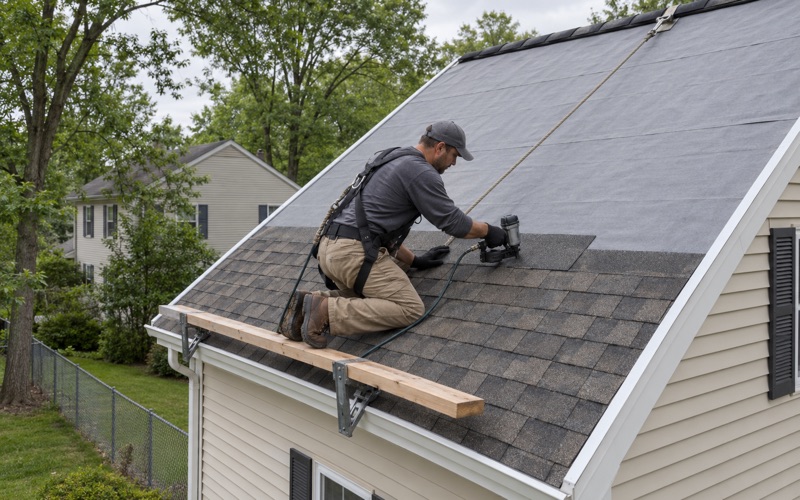
Tear-off is the loudest, messiest part of the job, and the day when the house is most exposed if weather turns. We schedule it on a day with a clear forecast and plan to have the roof dried in with underlayment and ice and water barrier before the crew leaves that evening. If you work from home, we can tell you in advance which hours will be noisiest so you can plan calls around them.
At the end of every work day we clean the driveway, yard and gutters and run a magnet sweep for roofing nails. When you come home from the train, the driveway should be safe to pull into.
Decisions that come up while you are at work
The most common surprise on a tear-off is damaged decking. When we find it, we photograph each bad sheet and send the photos to you before anything is replaced, at the per-sheet price already written into your contract. You can approve from your phone on the train instead of taking a call in the middle of the workday.
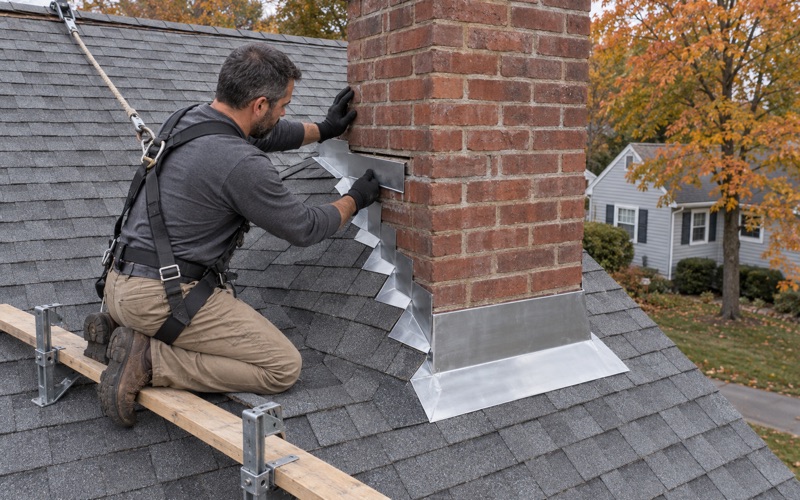
Flashing is not a surprise decision. Step, counter and chimney flashing is replaced with the roof as part of the scope rather than reused under new shingles, and attic ventilation is checked on every replacement because a roof that cannot breathe ages from below.
Contracts, cancellation and solar panels
Our contracts are written to New Jersey’s home improvement rules, including the three-business-day cancellation notice. If your house has solar panels, we put the panel removal and reinstall in the schedule from the start, so a commuting owner is not left coordinating two contractors on the morning of the job.
Leak Tracing and Inspection Reports When Nobody Is Home
A leak is harder to deal with when the only person who has seen the stain is at a desk in Manhattan. We set up leak visits so the owner does not have to be there for all of it, but the attic still has to be opened.
Attic access for a leak trace
We need to see the underside of the roof, not just the top, to find where water actually enters. Before the visit we confirm how we get into the attic, whether through a hatch in a closet, a pull-down stair or a finished room, and who will let us in. Many commuting owners arrange for a neighbor, a family member or a work-from-home spouse to open the house for the first hour.
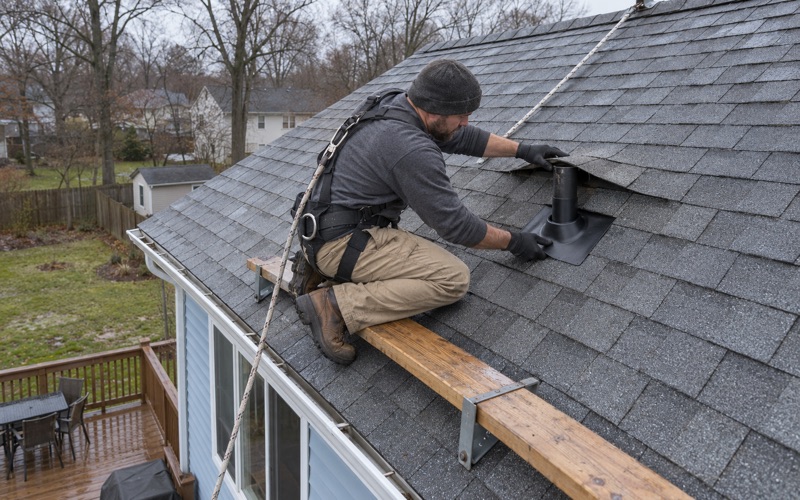
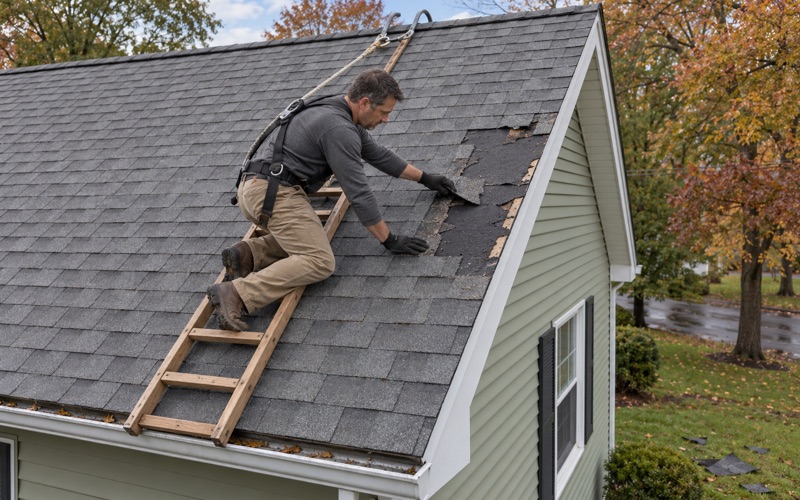
Once inside, we follow the water marks on the rafters and sheathing back toward the source, then check the matching spot outside: a lifted shingle, a cracked pipe boot, failed step flashing or a gap at the chimney. Only then do we tell you whether it is a repair or something bigger.
How the inspection is reported
Every inspection ends with a written report and photos. The report shows what we found in the attic, what we found on the roof, and whether we recommend a repair, and it is written so you can read it on a phone between stops. If you are selling, we can prepare a written roof condition report you can hand to the buyer’s inspector.
After a storm, we photograph the damage and write it up for your own insurance claim. If you ask, a member of our crew will meet the adjuster at the house, which saves a commuting owner a day off work.
Gutters and leaders
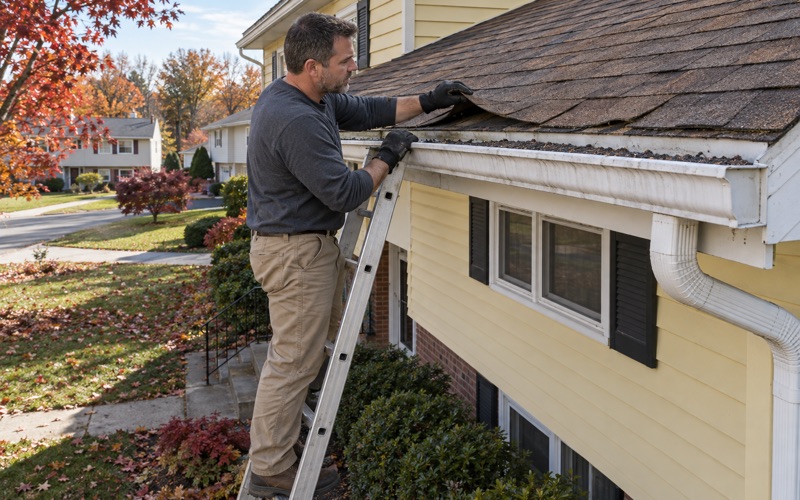
A lot of what looks like a roof leak is water that never left the gutter. We size and pitch seamless aluminum gutters and leaders with the roof so water is carried away from the house rather than toward the foundation, and we check them on every leak visit as part of the same trip.
- 20+ Years Roofing
- Itemized Written Estimates
- Attic-to-Ridge Leak Tracing