Piscataway Roofing brings more than 20 years of roofing in Readington and the rest of central New Jersey to two very different kinds of jobs. Most calls come from houses, where the roof is pitched, shingled and governed by a simple state rule. The rest come from offices, warehouses and campus buildings, where a commercial roof is flat or nearly flat, carries drains and mechanical equipment, and moves through the township’s permit process before a crew sets foot on it.
Whichever building it is, we begin a leak call underneath as well as on top, so the water is followed back to the spot where it actually gets in before a single line is priced. You hear plainly whether the roof can be repaired before replacement ever comes up. When replacement is the honest answer, our written scope separates tear-off, decking, underlayment, flashing, ventilation and drainage, so a competing bid can be checked against it line by line.
This page starts with the commercial side, because Readington holds a building that changes what roofing means here. Homeowners will find their own questions answered in the last section.
The former Merck headquarters and the permit line
A corporate campus in Whitehouse Station
The former Merck headquarters stands at 1 Merck Drive, in the Whitehouse Station section of Readington Township. It was designed by Kevin Roche John Dinkeloo and Associates, built from 1989 to 1990 and inaugurated in 1992. According to Wikipedia, the three-story building holds 900,000 square feet of office space above 700,000 square feet of parking, because Merck placed the parking structure underground rather than spreading it across the grounds.
Merck announced in 2012 that it was moving its main operations to Summit. UNICOM Science and Technology Park completed its purchase of the property on October 1, 2018, and the site now carries that name. Real Estate NJ described it at the time as a 1,100-acre office campus with roughly 2 million square feet of office space, including data centers, a central utility plant and solar farms, while ROI-NJ reported 1.2 million square feet of office, research and manufacturing space. The figures differ by source, and we repeat each one only beside the outlet that printed it.
None of the sources we read describe the building’s roof, its covering or its age, so we will not guess at any of them here. What the campus does show is the scale of commercial property in this township. A building like that is not a big house, and its roof is not handled like one.
Why a commercial roof is permit work
New Jersey’s ordinary-maintenance rule in the state construction code lists the repair or replacement of existing roof covering on detached one- and two-family dwellings. That wording stops at those houses. An office building, a store, a warehouse or a medical suite falls outside it, so re-roofing a commercial building in Readington is construction-permit work.
Permits here run through the Readington Township Construction Department at 509 Route 523 in Whitehouse Station, where Thomas Petto is the construction official and the main line is (908) 534-2164. The department’s page lists a construction permit application and a construction record clearance form, but it publishes no statement about roofing. A permit also brings inspections, so the schedule leaves room for them between tear-off and final sign-off. We confirm the submittal list with the office before a commercial job is scheduled, rather than assuming it matches another town’s.
Looking for roofing closer to South Orange Village? See Roofing in South Orange Village.
Low-slope membranes, roof drains and rooftop units
Choosing a membrane
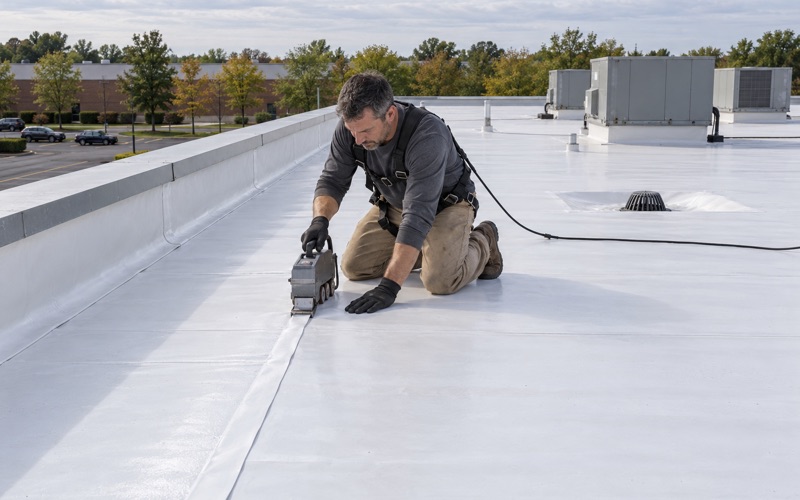
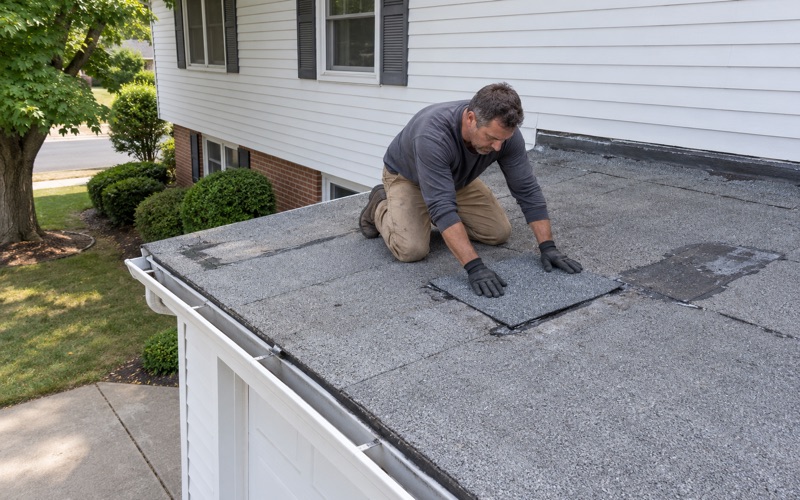
Commercial buildings of this form are usually covered with a low-slope membrane rather than shingles. The common systems are EPDM rubber, TPO and PVC single-ply sheets, and torch-down SBS or APP modified bitumen. Each one seals differently at seams, edges and penetrations, and each tolerates foot traffic, heat and standing water in its own way.
We do not pick a membrane before we have opened the existing roof. A core cut shows how many layers are already there, what insulation sits below and whether that insulation is wet. That one sample often decides whether the job is a targeted repair, a recover over sound insulation or a full tear-off to the deck.
Drains, scuppers and ponding
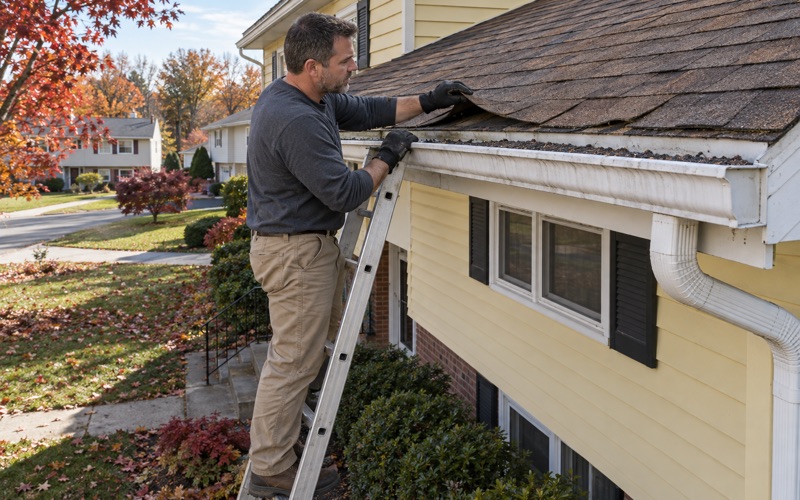
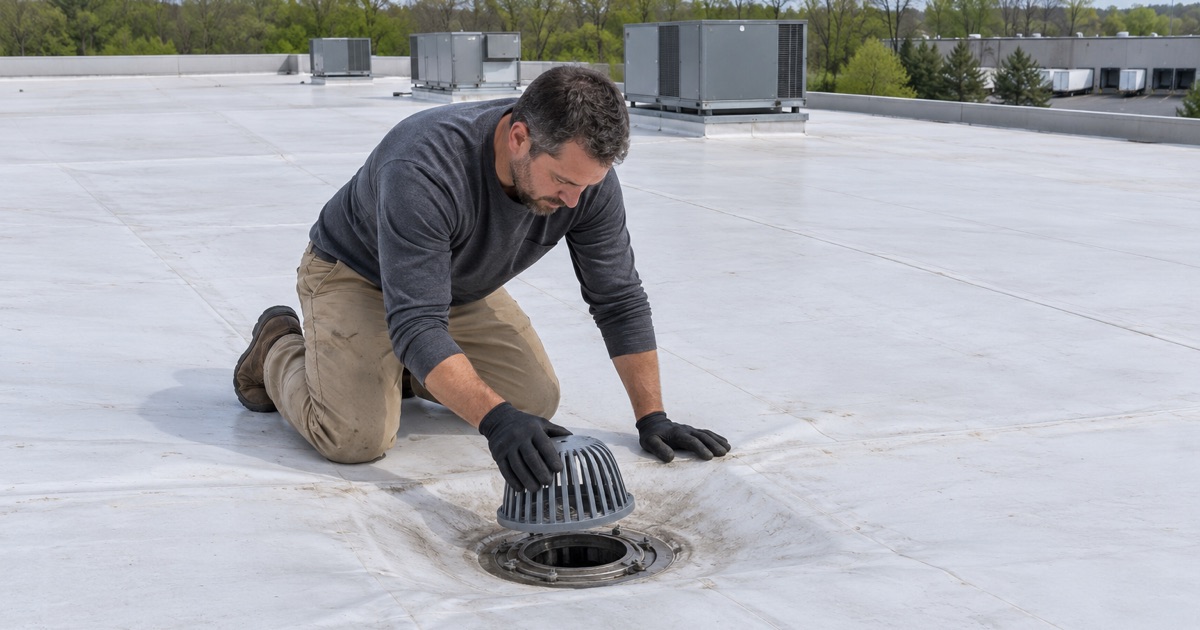
A flat roof works only if water leaves it, and on a large building that usually means interior roof drains and edge scuppers. Clogged strainers, sagging deck and crushed insulation leave ponds that sit for days, and a membrane under standing water ages much faster than the rest of the field. We clear and inspect every drain before a repair is priced, because a leak that looks like a membrane failure is often water backing up from a blocked outlet.
When a roof is replaced, we check the slope to each drain and add tapered insulation or crickets where water has been pooling. Gutters and leaders on lower roofs and entrances are sized and pitched at the same time, so the water reaches the storm system instead of the foundation or the sidewalk.
Rooftop units and penetrations
Rooftop units, exhaust fans, pipe supports and conduit runs each pierce the membrane, and those penetrations are where most commercial leaks start. Curbs need flashing carried up their sides, pipes need boots or pitch pockets, and the paths technicians walk need protection pads. We coordinate with the building’s mechanical contractor when a unit has to be lifted, disconnected or reset on a new curb, so the roof and the equipment are finished as one job.
Abandoned curbs and dead penetrations are worth removing during a replacement. Every opening that no longer serves a purpose is one more place for water to enter, and closing it while the deck is exposed costs far less than chasing a leak from it later.
Planning roof work around occupied offices
Keeping a working building dry
An office roof is usually replaced while people are working below it. We tear off and dry in one section at a time, sized so it can be closed and watertight by the end of each day. Weather is checked every morning, and nothing is opened that cannot be covered before rain arrives.
Before the first section is opened, the facility manager receives a written schedule showing which areas of the roof will be worked on each week. Spaces under the active section are checked for anything that should be covered or moved, such as servers, files or ceiling tiles already stained by past leaks. If a leak appears during the job, we respond the same day and trace it before anyone assumes the new work caused it.
Decking damage is common on older low-slope roofs once the covering comes off. Anything we find is photographed and shown to the owner or facility manager before it is replaced, at a per-sheet or per-square-foot price already written into the contract. That keeps a surprise from turning into an argument halfway through the job.
Odors, noise and fresh-air intakes
Adhesives, primers and torch work all produce odors, and rooftop units pull outside air straight into the offices below. We map the fresh-air intakes before work starts and agree with the facility team on when those units can be shut down or switched to recirculate. Noisy tear-off can be scheduled early in the day or on weekends where the tenants prefer it.
Access, staging and cleanup
A large commercial roof needs a hoist or crane, a staging area and a clear route for material and debris. We plan those with the property manager so parking, deliveries and entrances stay usable. At the end of every work day the lot, the walkways and the roof are cleaned, including a magnet sweep for fasteners and nails, because a tire puncture in an employee parking lot is a problem the building owner hears about first.
From corporate campuses to the houses around them
What Readington’s housing looks like
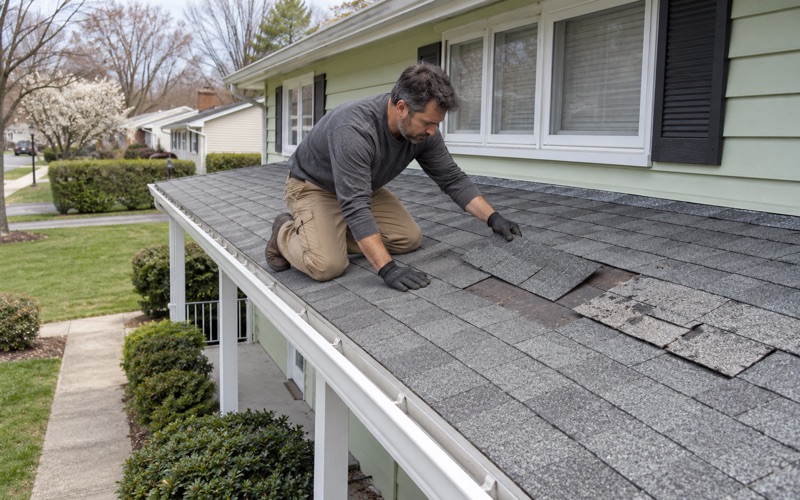
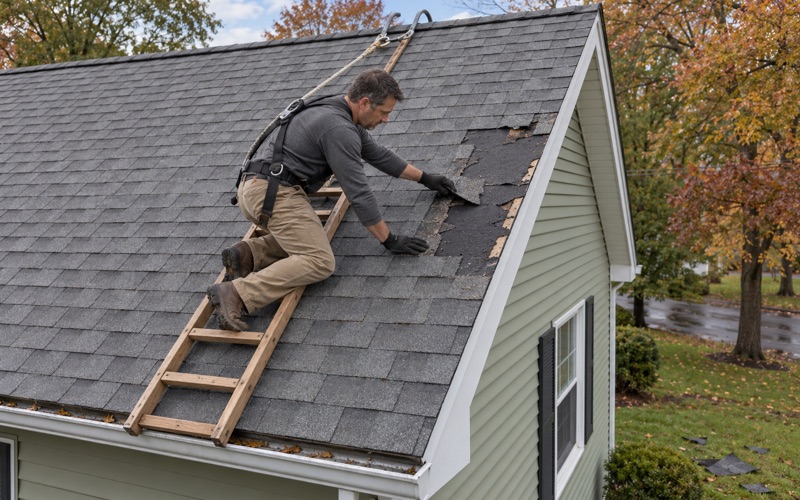
Readington is a Hunterdon County township, and most of its roofs sit on houses rather than offices. The 2024 American Community Survey five-year estimates count 4,852 detached homes out of 6,491, about 74.8 percent, along with 912 one-unit attached homes. About 56.5 percent of the township’s homes were built between 1970 and 1999, which means many original or second-generation roofs are reaching the point where repair and replacement both deserve an honest look.
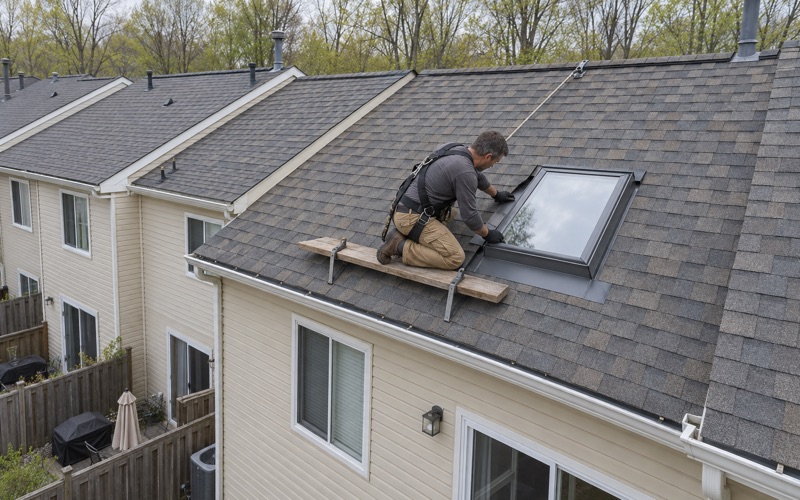
On a detached one- or two-family house, replacing the roof covering is ordinary maintenance under the state rule described above. Attached townhouse units are not covered by that wording, so we confirm the requirement with the construction department before work begins. In townhouse and condominium communities we also read the association’s documents to see who is responsible for the roof before we write any estimate.
Not every Readington house is lived in by its owner. The same survey counts 732 renter-occupied homes against 5,644 owner-occupied ones, and landlords get repairs scheduled around their tenants, with photos sent after each visit so the owner sees the work without driving out.
Flashing, ventilation and winter details
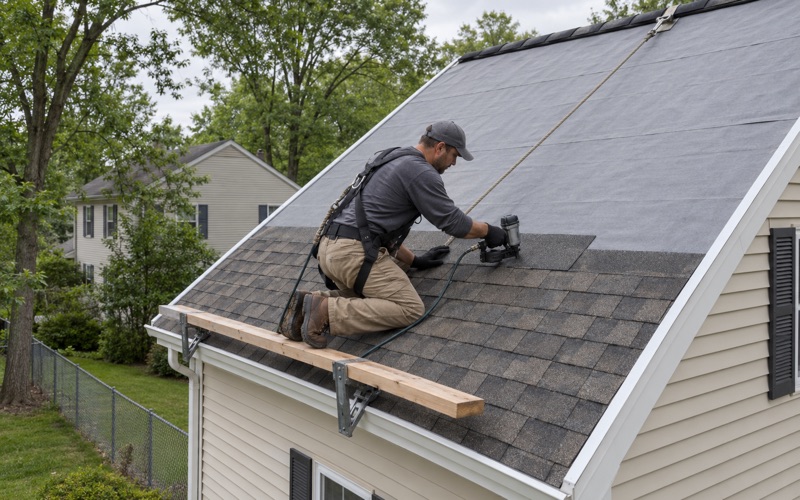
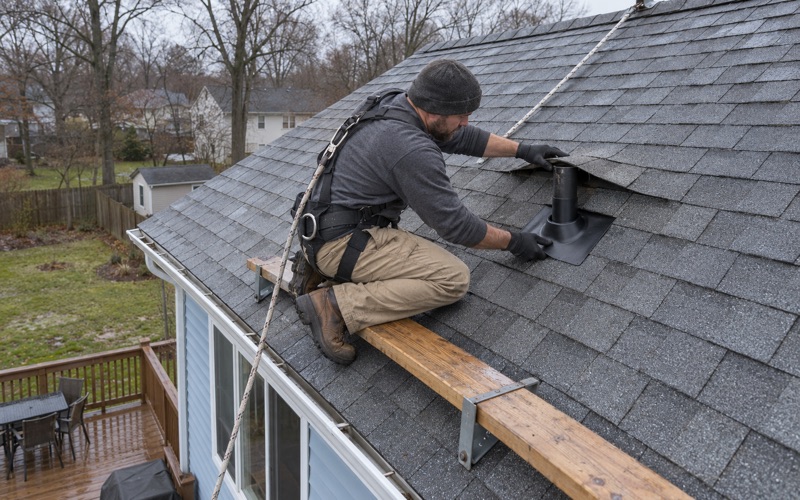
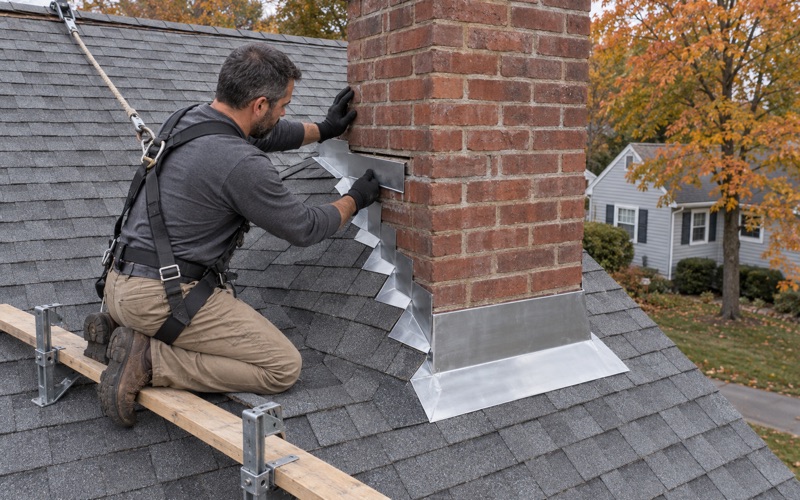
On every residential replacement, step, counter and chimney flashing is replaced with the new roof rather than reused under it. Attic ventilation is checked each time, because a roof that cannot breathe ages from underneath no matter how good the shingle is. Drip edge goes on at eaves and rakes, and pipe boots are replaced as part of the job.
Hunterdon County is not in New Jersey’s code-required ice barrier area. Department of Community Affairs Bulletin 07-3 names only Sussex County as meeting that threshold, and the 1991 to 2020 January average normal at the Flemington 5 NNW station is 29.2 degrees. We still install a self-adhering ice and water barrier at the eaves when the shingle manufacturer calls for it, and we tell you which reason applies.
Storms, sales and paperwork
After a storm we photograph the damage and write it up so you can file your own claim, and we will meet the insurance adjuster on site if you ask. Homeowners selling a house can get a written roof condition report to hand to the buyer’s inspector. Every residential contract follows New Jersey’s home improvement rules, including the three-day cancellation notice, so you know exactly what you signed and how long you have to change your mind.
- 20+ Years Roofing
- Itemized Written Estimates
- Attic-to-Ridge Leak Tracing