Piscataway Roofing has spent more than 20 years on roofing in Somerville and the surrounding part of Central Jersey, and most of what we do here is ordinary work: a leak over a bedroom, worn shingles on a ranch, a gutter run that dumps water at the foundation. Where Somerville differs is the paperwork that can sit behind a roof estimate on certain blocks. A number on our proposal can end up in front of someone other than the homeowner, so we write it to be read that way.
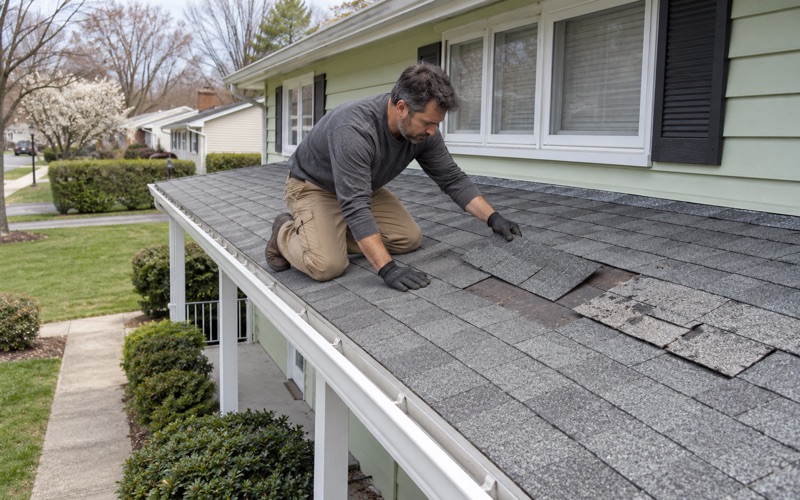
We start with the question every owner asks first, which is whether the roof can be fixed. You get a straight answer on repair before replacement comes up at all, and on a leak call we look in the attic as well as on the roof so the water is traced to where it actually enters. If replacement is the honest answer, the written scope breaks tear-off, decking, underlayment, flashing, ventilation and gutters into separate lines.
That itemized format matters more in Somerville than in most towns we serve, for reasons that trace back to one September night and an ordinance the borough passed two years later. The rest of this page walks through both, and through what we would ask before pricing a roof on a house near the water.
What Ida did along Peters Brook, and what Somerville changed afterward
Peters Brook runs through the borough on its way to the Raritan River, and for most of the year it is easy to forget it is there. On September 1, 2021, the remnants of Ida changed that. Residential blocks along the brook took on up to eight feet of water, and the Brookside Gardens apartments were badly damaged, displacing more than 150 residents.
A flood that reached past the expected lines
One detail from the coverage stays with us: a resident outside a designated flood zone had no flood insurance. That is a reminder that water does not read a map, and it is also a reason we never tell anyone in Somerville whether their own house sits inside or outside a mapped hazard area. We have not mapped it, and the borough is the place to ask.
Roofs were not the main story of Ida here, since the damage came up from the brook rather than down through shingles. But a house that took water often needs a lot of work at once, and a roof can be part of that list. How all of that work is counted is where the borough’s later ordinance comes in.
Ordinance 2708 and the ten-year window
In May 2023 the borough added a flood damage prevention article to its code, Article XIII, through Ordinance 2708. Section 102-127 defines substantial improvement as any reconstruction, rehabilitation, addition or other improvement taking place over a ten-year period whose cumulative cost equals or exceeds 50 percent of the structure’s market value before the work started. The administrator reviewing an application evaluates previous permits issued for improvements and repairs over the prior 10 years.
The practical effect is that projects are not judged one at a time. A kitchen one year, siding a few years later and other exterior work after that can be looked at together. Substantial damage is defined the same way, as damage of any origin whose restoration reaches 50 percent of pre-damage market value.
Looking for roofing closer to Denville? See Roofing Services in Denville.
Why FEMA lists roofing in the 50 percent figure
The federal guidance that floodplain programs lean on is FEMA P-758, the Substantial Improvement/Substantial Damage Desk Reference. In Section 4.4.1, under structural elements and exterior finishes, it lists roofing, gutters and downspouts among the costs that must be included in these determinations. Roofing does not appear among the exclusions in Section 4.4.2, which cover items such as clean-up, permit fees, plans and plug-in appliances.
Damage from wind counts the same as damage from water
Section 4.4 of the same reference says the substantial damage requirement applies regardless of the cause of damage, such as wind or fire. For a Somerville owner, that means a storm that tears up shingles is not automatically a separate category from a flood. The rule is about the building and its value, not about which direction the weather came from.
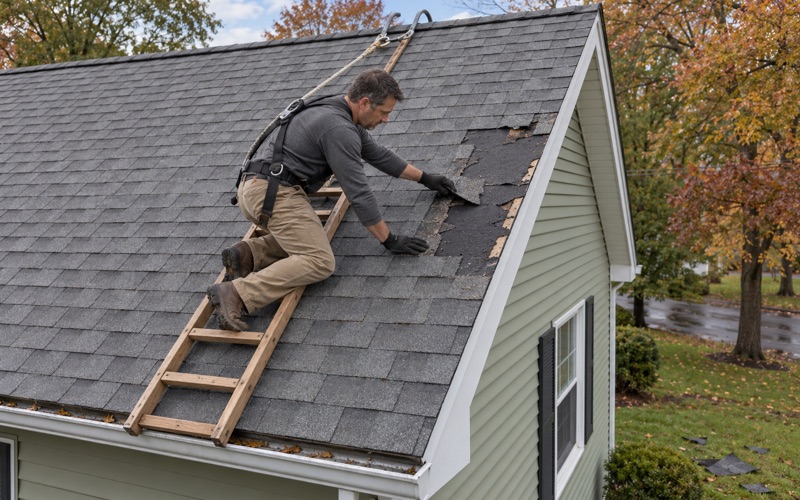
We photograph and write up storm damage for the owner’s own claim, and when asked we will meet the insurance adjuster on site. Those photos and that write-up describe the roof. They are not a floodplain determination, and we do not make one.
What the rule asks of a raised house
When a habitable building in an A zone is found substantially improved, the borough code requires its lowest floor at or above the local design flood elevation. Somerville sets that as the best-available flood elevation plus one foot of freeboard, or as the state flood hazard rules at N.J.A.C. 7:13 describe, and it is confirmed by an elevation certificate. That is a large undertaking, and it is the reason the cumulative count deserves attention well before a homeowner signs for a string of exterior projects.
What the code text does not settle
New Jersey treats roof-covering repair or replacement on a detached one- or two-family house as ordinary maintenance, with no construction permit, inspection or notice required under N.J.A.C. 5:23-2.7. Whether that kind of re-roof needs a floodplain development permit, or enters the ten-year tally under Section 102-127, is not something we have read in the borough’s text. We will not guess at it on your behalf, and we will not run the arithmetic for you.
Questions for the floodplain administrator before a re-roof
The borough’s flood damage prevention article is administered alongside the Uniform Construction Code and the New Jersey Flood Hazard Area Control Act. A Somerville floodplain administrator reviews work through a floodplain development permit, and the borough’s own summary says that review reaches minor improvements. If your house is anywhere near Peters Brook or the Raritan, that office is the one to call before a roof is priced.
What to bring to that conversation
The most useful thing to carry in is a clear record of what the house has already had done. Bring dates and costs for prior work over the last decade, along with any permits pulled, since the code looks back across that whole window. A rough idea of the home’s market value, from an appraisal or tax record, helps the conversation move.
A written roof estimate fits into that stack. Ours lists each part of the job separately, so the administrator can see which dollars go to the roof covering, which to gutters and downspouts, and which to items like decking or ventilation.
What to ask them directly
Ask whether your property lies in a mapped flood hazard area and, if so, which zone. Ask whether the roof work you are considering needs a floodplain development permit, and whether it would be counted toward the ten-year total. Ask what market value figure they would use and how prior work on the house has been recorded.
Those answers belong to the borough, and the conversation is yours to have. We do not file floodplain permits or deal with the administrator for an owner. What we can do is make sure the paperwork we hand you is specific enough to be useful when you walk in.
Pricing roof work on a Somerville house near the water
Once an owner has heard from the borough, we can price the roof in a way that fits what they learned. Sometimes that means a full replacement now. Sometimes it means a sound repair while the owner weighs a larger project, which is one more reason we give the repair answer first.
An estimate built in separate lines
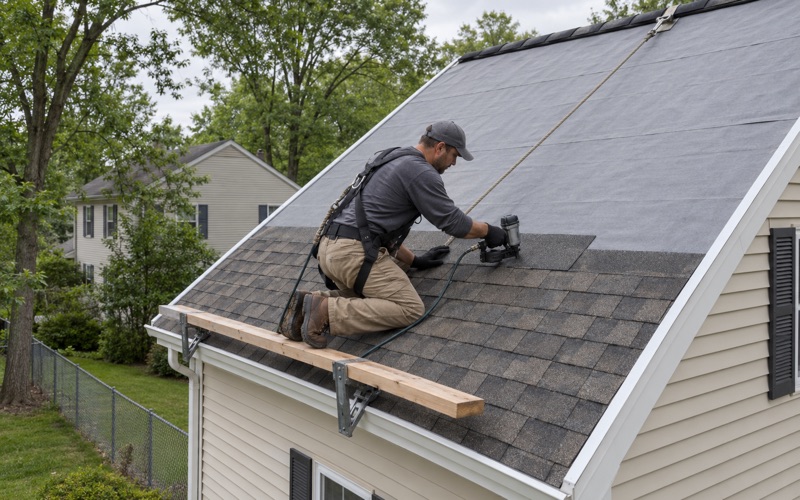
Our written scope breaks the job into tear-off, decking, underlayment, flashing, ventilation and gutters. Two contractors’ numbers can then be compared line by line, and an owner can see exactly where the money lands. If damaged decking turns up once the old roof is off, we photograph it and show you before replacing anything, at a per-sheet price already set in the contract.
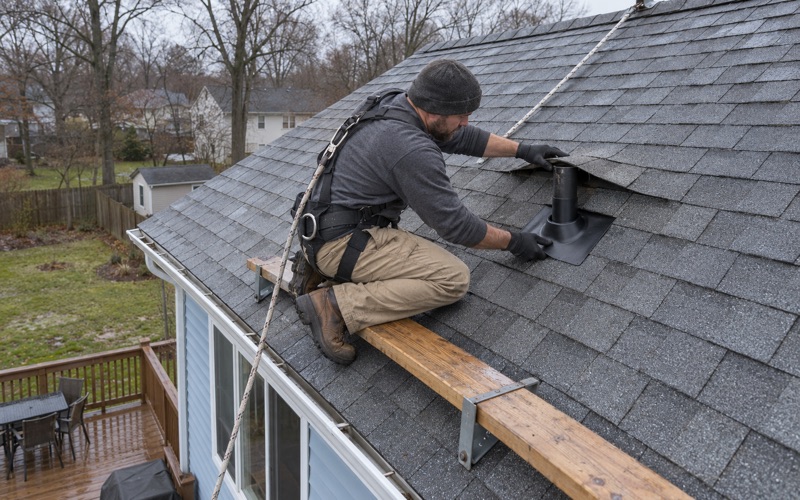
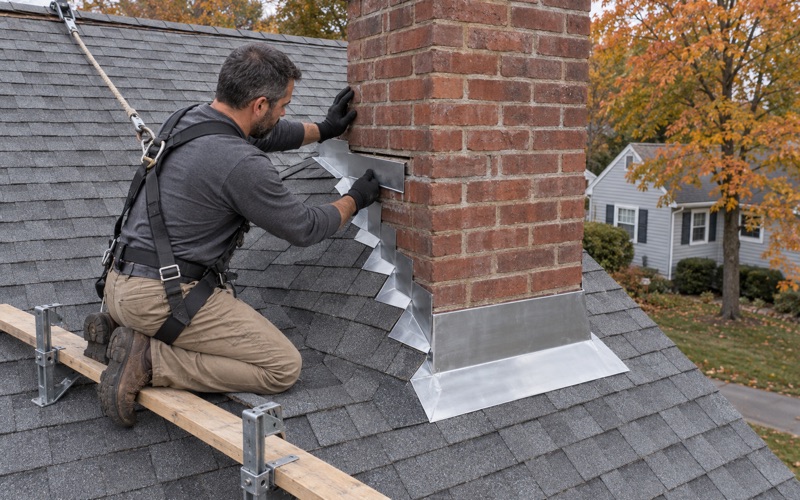
Flashing at walls, chimneys and other transitions is replaced with the roof rather than reused under new material. Attic ventilation is checked on every replacement, because a roof that cannot breathe ages from the underside. Each of those lines shows up on the estimate on its own, not folded into a single total.
Gutters and leaders that move water off the property
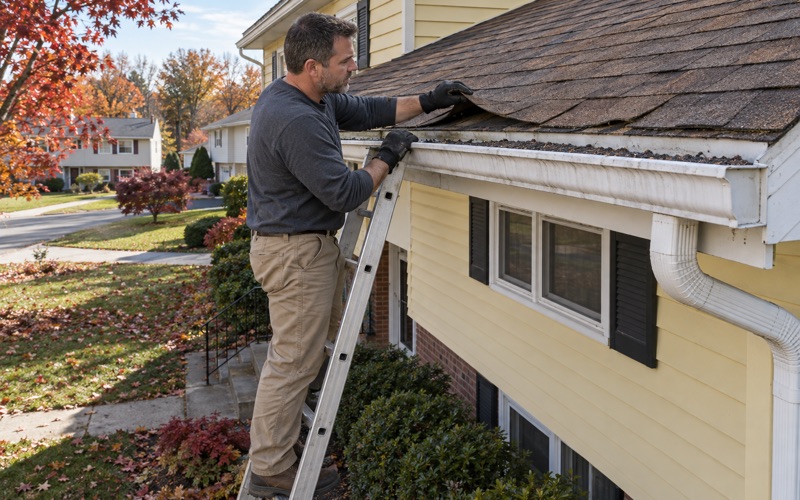
On a lot near Peters Brook, where the water goes after it leaves the roof is worth a careful look. We size and pitch gutters and leaders together with the roof so runoff is carried away from the house rather than toward the foundation. The borough code bars roof runoff from the sanitary sewer and sends it to designated storm sewers or a natural outlet approved by the Borough Engineer, and where a particular house’s leaders discharge is something we check on site.
Contracts, cleanup and the rest of the job
Contracts are written to New Jersey’s home improvement rules, including the three-day cancellation notice. At the end of every work day the driveway, yard and gutters are cleaned, with a magnet sweep for loose nails. Owners selling a house can get a written roof condition report to hand to the buyer’s inspector, and landlords get repairs scheduled around tenants, with photos sent after each visit.
If you own a house in Somerville and are weighing roof work, call us for an inspection and a written scope. Have it in hand before you talk to the borough, and you will be talking about real numbers instead of guesses.
- 20+ Years Roofing
- Itemized Written Estimates
- Attic-to-Ridge Leak Tracing